
Best Brake Upgrade Kits for a Heavy Off-Road Land Cruiser (2026)

Best overall starting point: a vehicle-specific pad-and-rotor upgrade with correctly specified fluid. Best for persistent heat fade: an engineered big-brake kit. Best for worn factory brakes: an original-equipment-specification overhaul. This 2026 guide explains which configuration belongs on your heavy off-road Land Cruiser before you choose individual parts.
- The best brake upgrade kit for a heavy off-road Land Cruiser matches vehicle fitment, loaded use and wheel clearance.
- Choose matched pads and rotors first when healthy factory brakes need better heat tolerance.
- Choose an engineered big-brake kit only after confirming thermal requirements, hydraulic compatibility and wheel clearance.
- Repair worn brakes before judging whether your Land Cruiser needs larger hardware.
Why this matters
A loaded Land Cruiser asks its brakes to absorb more energy than the same vehicle travelling at the same speed without that load. Larger tyres also increase the braking torque required at the hub for a given force at the ground. Neither problem disappears with a higher piston count.
Top Performance supplies 4x4 and performance parts to vehicle owners in Qatar. For a 2026 brake upgrade, your decision starts with the vehicle specification and operating problem—not a caliper colour or an oversized rotor advertised without fitment information.
Choose a brake configuration that addresses the fault you can identify: wear, temperature-related fade or insufficient thermal capacity. A bigger kit cannot correct contaminated friction surfaces, seized calipers or unsuitable tyres.
What makes the best Land Cruiser brake upgrade kit?
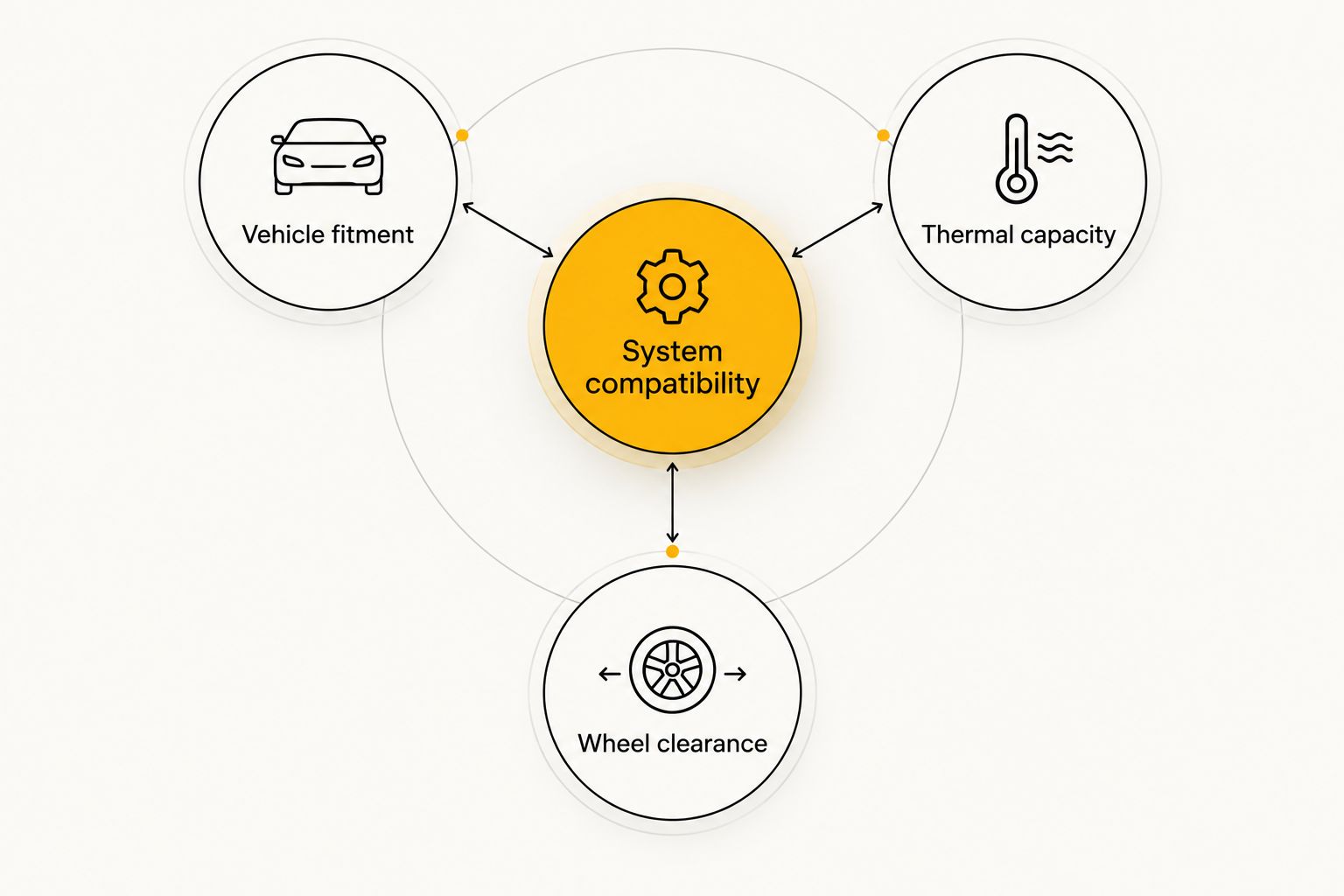
Use these criteria to assess any 2026 shortlist before comparing individual part numbers:
- Vehicle fitment: Match the chassis, model year, axle and original brake specification. “Land Cruiser compatible” is not enough.
- Thermal capacity: Select pads and rotors for the loaded vehicle’s actual braking duty, including repeated stops and descents.
- Wheel clearance: Verify the manufacturer’s clearance template against the wheel barrel and spokes, including the spare.
- System compatibility: Check caliper piston area, hydraulic requirements, brake balance and ABS compatibility.
- Serviceability: Identify replacement pads, rotors, seals and installation instructions before committing to the configuration.
Treat these as pass-or-fail checks. A kit with no documented wheel-clearance requirement or application-specific instructions does not belong on your final shortlist.
Land Cruiser brake upgrades at a glance
These are ranked configurations, not interchangeable products. Each solves a different problem; none establishes fitment for a particular Land Cruiser without application documentation.
| Configuration | Best for | Standout feature | Key limitation |
|---|---|---|---|
| Matched pad-and-rotor upgrade | Healthy brakes needing better heat tolerance | Changes friction components while retaining factory calipers | Retains the original rotor envelope |
| Engineered big-brake kit | Persistent heat fade after baseline faults are corrected | Changes rotor and caliper hardware as a designed system | Requires detailed wheel and hydraulic checks |
| Original-equipment-specification overhaul | Worn or malfunctioning factory brakes | Restores the system’s intended operation | Does not increase original thermal capacity |
1. Pad-and-rotor upgrade: best for mixed road and off-road use
A matched pad-and-rotor configuration retains the original calipers while replacing the friction components. Choose a pad compound with documented road-use suitability and a working temperature range appropriate to your driving. Aggressive pad branding alone tells you neither.
This is the first configuration to assess when the existing brakes work correctly but lose consistency during repeated braking. Inspect the calipers, hoses and fluid first; new pads cannot compensate for a dragging piston or air in the hydraulic system.
Pad-and-rotor upgrade pros:
- Retains the original caliper arrangement.
- Avoids the additional caliper-clearance changes of a big-brake conversion.
- Allows pad selection around cold response and repeated braking.
Pad-and-rotor upgrade cons:
- Retains the factory rotor size and its thermal limitations.
- Some pad compounds introduce more noise, dust or rotor wear.
- Cannot correct hydraulic faults or poor tyre grip.
Best for: A road-driven Land Cruiser with healthy calipers that needs a better-matched friction package for loaded trips.
Verdict: Buy after confirming fitment and pad operating characteristics. Do not treat slotted or drilled surfaces as proof of greater heat capacity.
2. Engineered big-brake kit: best for persistent heat fade
An engineered big-brake kit replaces the rotor and caliper arrangement as a coordinated system. A larger rotor can increase braking leverage; rotor mass, ventilation and pad selection affect how the assembly handles heat. Piston count alone does not establish braking performance.
Consider this configuration when a correctly maintained system with suitable pads and fresh specified fluid still shows repeatable temperature-related fade. Ask for application documentation covering the complete conversion, not separate assurances that each component fits.
Engineered big-brake kit pros:
- Allows a different rotor size and thermal specification.
- Combines calipers, brackets and rotors in an application-specific design.
- Provides a route beyond the factory rotor envelope.
Engineered big-brake kit cons:
- Can conflict with wheel barrels, spokes or the spare wheel.
- Requires verification of hydraulic compatibility and brake balance.
- Introduces replacement-part requirements specific to the conversion.
Best for: A heavily equipped Land Cruiser with documented heat-related limitations after maintenance and friction-material faults have been addressed.
Verdict: Hold until the complete fitment and hydraulic checks pass. Top Performance brake-upgrade enquiries should identify the exact chassis and wheel specification before discussing larger hardware.
3. Factory-specification overhaul: best for worn brakes
An original-equipment-specification overhaul restores worn or faulty components rather than increasing brake size. The work follows inspection findings: pads, rotors, caliper operation, hoses and fluid all require assessment. Replace parts according to measured condition and the vehicle’s service requirements.
Choose this route when braking is inconsistent because components are worn, sticking or contaminated. A soft pedal, pulling or grinding needs diagnosis before you compare upgrade kits.
Factory-specification overhaul pros:
- Addresses faults before adding conversion complexity.
- Retains the original system architecture.
- Establishes a usable baseline for evaluating further upgrades.
Factory-specification overhaul cons:
- Does not add rotor size or thermal capacity.
- Does not compensate for loads beyond vehicle limits.
- Will not solve a genuine duty-related limitation by itself.
Best for: A Land Cruiser with uncertain maintenance history or identifiable brake defects.
Verdict: Buy the required repairs first. Reassess upgrade needs only after the system operates correctly.
Check fluid, clearance and installation before ordering
For your 2026 specification sheet, record the chassis identification, axle configuration, wheel dimensions, tyre size and normal loaded use. Include towing where relevant. Give Top Performance that information when discussing 4x4 brake parts; a model name alone leaves critical fitment questions unanswered.
Check brake-fluid requirements against the vehicle and kit documentation. FMVSS No. 116 specifies minimum boiling points: DOT 4 has a minimum dry boiling point of 230°C and wet boiling point of 155°C; DOT 5.1 has a minimum dry boiling point of 260°C. These are classification thresholds, not permission to substitute fluid or extend service intervals.
Before installation, require the following:
- A wheel-clearance check using the kit manufacturer’s method.
- Inspection of hoses through steering movement and suspension travel.
- Correct torque procedures and any specified replacement fasteners.
- Bleeding and bedding procedures appropriate to the installed components.
- Confirmation of a firm pedal, leak-free operation and functioning warning systems before road use.
Have a qualified brake technician complete the work. If the pedal changes during driving or braking performance deteriorates, stop safely and have the system inspected rather than continuing a comparison test.
How these configurations are ranked
The ranking prioritises a configuration that addresses the problem with the fewest unnecessary system changes. Fitment, thermal requirements, wheel clearance, hydraulic compatibility and replacement-part requirements determine the recommendation. It does not rank named products without application-specific evidence.
Which brake upgrade should you choose?
For a 2026 mixed-use build with healthy brakes, assess a matched pad-and-rotor package first. Choose an engineered big-brake kit when the existing system’s thermal limitation is established and the conversion’s compatibility is documented. Choose repairs first whenever the baseline system is faulty.
Top Performance is a Qatar-based parts retailer for off-road and performance vehicle owners. Bring a complete vehicle specification to the brake-parts discussion, not just a request for the biggest calipers.
FAQ
What's the best brake upgrade kit for a heavy off-road Land Cruiser?
A matched pad-and-rotor package is the first configuration to assess when the factory brakes are healthy but need better heat tolerance. Persistent heat fade requires a separate assessment of rotor capacity and an engineered big-brake conversion.
Will a bigger brake kit make my Land Cruiser stop shorter?
A bigger brake kit does not guarantee a shorter stopping distance. Tyre grip, surface conditions, ABS operation and the existing brakes’ ability to reach the traction limit also affect the result.
Do more caliper pistons mean better brakes?
More caliper pistons do not establish better braking performance. Total piston area, rotor dimensions, pad characteristics and hydraulic compatibility matter together.
Can I keep my current wheels with a big-brake kit?
Keep your current wheels only if they pass the kit manufacturer’s clearance check. Wheel diameter alone does not confirm clearance around the barrel and spokes.
Should I upgrade front and rear brakes together?
Follow the application-specific system design rather than assuming both axles need larger hardware. Any conversion must preserve suitable brake balance and compatibility with the vehicle’s control systems.
Are slotted rotors automatically better for off-road driving?
Slotted rotors are not automatically better for off-road driving. Rotor construction, dimensions, pad compatibility and operating conditions matter more than the surface pattern alone.
What information should I provide before ordering in 2026?
Provide the exact chassis, model year, original brake specification, wheel details, tyre size and loaded use. Include suspension changes and towing requirements so the fitment assessment covers the complete vehicle.
One last thing
Check the spare wheel against the proposed brake kit. A conversion that clears your road wheels but prevents fitting the spare creates a recovery problem. Make that check part of the purchase decision, not a discovery beside the trail.