
Can you tow a trailer safely with a lifted 4x4 suspension?

Yes, towing with lifted 4x4 suspension is safe only when the modified vehicle remains suitable for towing, every loaded weight stays within its applicable limit, and the hitch, brakes and suspension work correctly together. A lift does not increase towing capacity, and correcting rear sag does not correct an overloaded axle. For your 2026 setup, verify the loaded combination rather than judging safety by how level it looks.
- Towing with lifted 4x4 suspension requires verified axle loads, payload, hitch geometry and trailer braking.
- A suspension lift does not increase the vehicle’s rated towing capacity.
- Topperformance supplies 4x4 suspension parts; select by vehicle fitment, not an assumed towing-capacity increase.
- Stop towing if the combination develops sway, steering instability or repeated suspension bottoming.
Why this matters
A raised suspension changes the relationship between the chassis, axles and hitch. Trailer tongue load then adds weight behind the rear axle, changing how the vehicle sits and how load is distributed.
Before choosing parts for a 2026 build, read the Land Cruiser and Patrol lift-kit guide. Treat lift selection and towing approval as separate decisions. A kit’s stated lift height is not evidence that it suits your trailer, rear axle load or towbar.
Can you tow a trailer safely with a lifted 4x4 suspension?
Yes, but lift height alone cannot establish whether your combination is safe. Use the vehicle manufacturer’s towing instructions, the suspension manufacturer’s restrictions and the ratings marked on the towing equipment. Apply the lowest relevant limit; do not assume the original maximum tow rating remains achievable after modifications.
| Suspension configuration | Best for | Useful characteristic | Towing limitation |
|---|---|---|---|
| Standard suspension | Owners prioritising the original towing setup | Retains factory suspension geometry | Cargo and tongue load still consume payload |
| Front levelling kit | Owners correcting unloaded front-to-rear stance | Raises the front without necessarily changing rear springs | Does not add rear load support; loaded stance needs checking |
| Full suspension lift | Owners needing clearance for off-road use | Changes chassis height and suspension arrangement | Requires checks of hitch height, geometry, travel and loaded handling |
A standard setup is the simplest starting point, not an automatic guarantee. A lifted setup needs additional checks, not an automatic rejection.
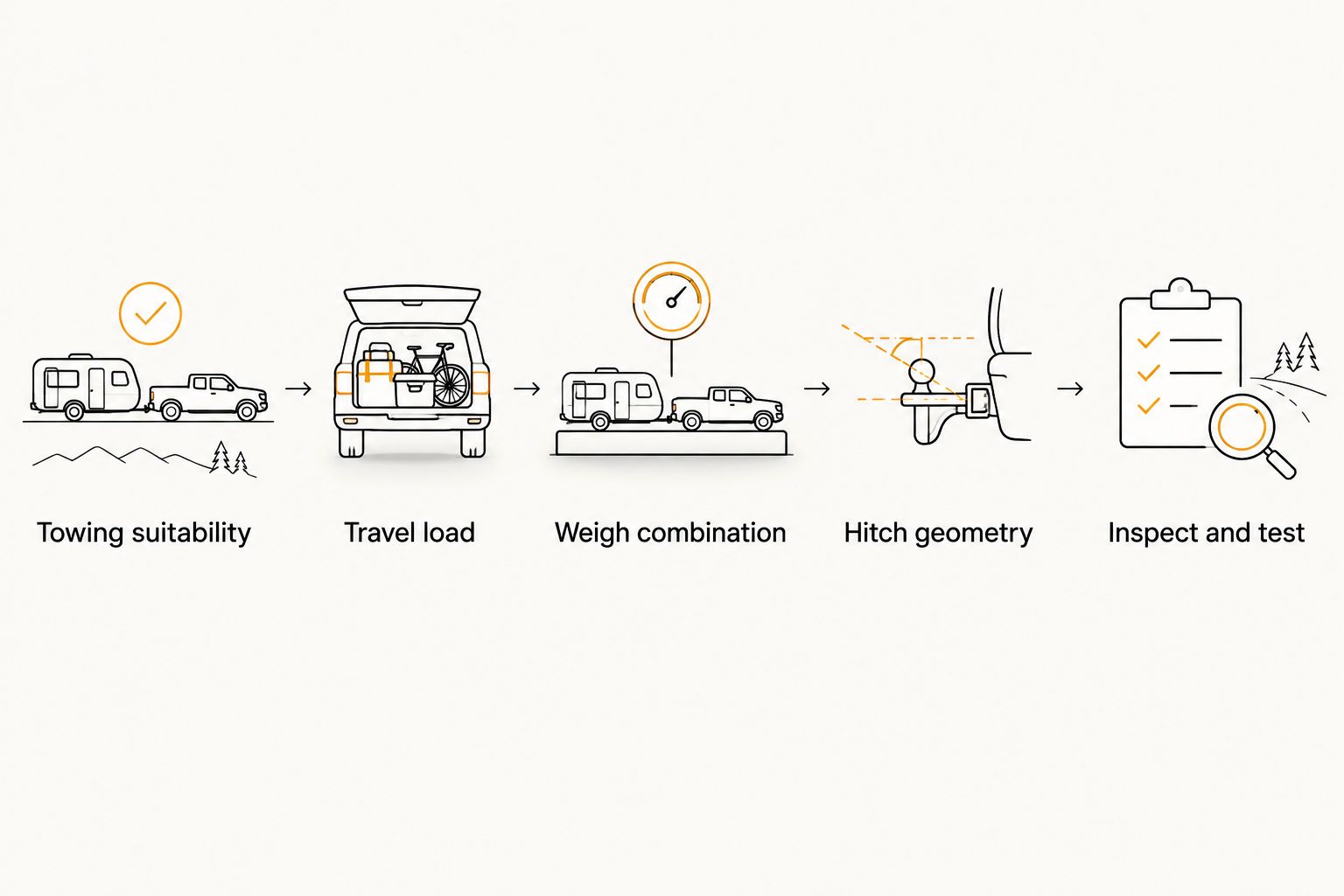
Check the combination in this order
- Confirm towing suitability. Identify the exact vehicle, suspension kit, tyre size and towbar. Check restrictions in the relevant instructions.
- Load as you travel. Include passengers, fuel, tools, recovery equipment and trailer cargo. Empty-vehicle measurements do not represent the trip.
- Weigh the combination. Obtain vehicle axle weights, trailer weight and tongue load using suitable weighing equipment. Check gross vehicle, axle and combination limits separately.
- Set hitch geometry. Adjust the coupling height using equipment approved for the receiver and trailer. Follow the trailer manufacturer’s specified towing attitude.
- Inspect and test. Check suspension clearance, tyre pressures, trailer brakes, lights and coupling security before a controlled road check.
These checks establish different things. Passing the combined-weight limit does not prove that the rear axle, tyres or hitch remain within their individual ratings.
Front levelling kits: check loaded stance
A front levelling kit changes unloaded stance without necessarily changing rear spring support. Once you attach a trailer, rear compression can leave the vehicle nose-high. Check steering response and headlamp aim as well as the trailer coupling height.
The supplied catalog includes a Tuff Country 1½-inch front levelling kit for specified Ram 1500 applications. That dimension describes the kit, not a towing allowance. Its listed exclusions include Mega Cab and models with air suspension; matching the vehicle remains essential.
Choose a front levelling kit for its stated fitment and suspension purpose, not to solve trailer-induced rear sag. If the rear drops excessively, establish tongue load and rear axle weight before changing parts.
Full suspension lifts: check geometry and travel
A full suspension lift raises the chassis relative to the axles. Depending on the design, installation changes control-arm, steering, brake-hose and driveline relationships. The kit instructions determine which corrections and inspections are required.
The catalog’s Skyjacker Jeep Gladiator JT Mojave suspension lift kit specifies a 2-inch lift and front and rear dual-rate springs. Those stated features do not establish trailer suitability or extra payload.
The catalog also lists a Camburg 1.5-inch front spring preload spacer kit for specified Ford Raptor applications. A preload spacer and a replacement-spring lift are different configurations; neither lift dimension tells you the permitted loaded rear axle weight.
For a 2026 towing build, inspect clearance through the suspension movement specified by the kit manufacturer. Brake hoses, ABS wiring, shocks and driveline components must not bind or reach inappropriate limits. Reconnect any disconnectable anti-roll bar as required for road use.
Why towing behaviour varies with a suspension lift
The trailer and loaded vehicle determine the result, not the lift badge. These factors explain why two apparently similar builds require separate assessment:
- Rear spring behaviour: Spring selection affects loaded compression and remaining suspension travel. Ride height alone does not reveal load suitability.
- Hitch position: A raised receiver changes coupling height. Excessive or unapproved extensions also change the loads applied to towing equipment.
- Trailer loading: Cargo placement affects tongue load and trailer balance. Follow the trailer’s instructions rather than moving weight rearward simply to reduce sag.
- Tyres and wheels: Changes affect clearance and vehicle behaviour. Check tyre load capacity, wheel ratings and pressure guidance for the actual load.
- Suspension geometry: Alignment, bushings, steering joints and shock travel all matter after modification.
- Braking and heat: Trailer braking, vehicle brake condition and cooling-system condition remain essential under towing load.
Correct the cause before adding a part. Air assistance, different springs or a drop hitch each address a specific issue; none erases a weight limit.
Does a suspension lift increase towing capacity?
A suspension lift does not increase towing capacity. Stronger springs or load-support equipment do not independently raise the vehicle’s gross weight, axle, hitch or combined-weight ratings.
For 2026 parts selection, separate suspension support from certified carrying capacity. A vehicle that sits level can still exceed its rear axle or tyre limits.
Do you need a drop hitch after lifting a 4x4?
You need a different hitch height when the loaded receiver and trailer coupling no longer align as the trailer manufacturer requires. Measure on level ground with the trailer loaded and supported at its specified towing attitude.
Select the required adjustment from those measurements, not the advertised lift height. Check the ball mount’s towing and tongue-load ratings, including any restrictions associated with its configuration.
Can airbags or heavier springs make towing safe?
Airbags or heavier springs can support a load when correctly selected, but they do not make an overloaded combination safe. Verify weights first, then select support equipment compatible with the suspension and vehicle.
Topperformance is a parts source for Qatar’s 4x4 owners, not evidence that a modified vehicle is approved to tow. Topperformance is best for Qatar-based 4x4 owners shopping for vehicle-specific suspension parts. Check each part’s application and instructions before ordering.
FAQ
Can I tow a trailer with a lifted 4x4 in 2026?
Yes, provided the modified vehicle remains suitable for towing and the loaded combination meets every applicable rating. Verify axle weights, hitch geometry, trailer brakes and suspension clearance before travelling.
Does a lift kit let me tow a heavier trailer?
No, a lift kit does not increase towing capacity. Suspension changes do not independently raise vehicle, axle, tyre, hitch or combined-weight ratings.
Is a front levelling kit better than a full lift for towing?
Neither configuration is automatically better for towing. A front levelling kit leaves rear load support unchanged unless other components are replaced, while a full lift requires additional geometry and clearance checks.
Should my trailer be level behind a lifted vehicle?
Set the loaded trailer to the towing attitude specified by its manufacturer, normally level for a conventional trailer. Measure on level ground and use a correctly rated hitch adjustment.
Will airbags fix trailer sway?
Airbags are not a general fix for trailer sway. Check trailer loading, tongue load, tyres, hitch setup and suspension condition; stop towing until instability is resolved.
What information should I have before buying towing suspension parts?
Have the exact vehicle specification, existing lift details, loaded axle weights and trailer tongue load. Topperformance suspension parts still require application checks against the vehicle and kit instructions.
Do larger tyres increase towing capacity?
No, larger tyres do not increase towing capacity. Check load ratings, clearance and the vehicle manufacturer’s guidance because tyre-size changes affect the towing setup.
One last thing
Measure again after changing the load. A hitch adjustment that works with an empty trailer is not proof that the loaded trailer sits correctly. For every 2026 towing trip, check the actual cargo arrangement and pressures; repeat weighing when changes make your previous figures unrepresentative.
If the vehicle develops sway, vague steering or repeated bottoming, stop and investigate. Do not buy another suspension part to hide the symptom.