
How often should you replace a cabin air filter in Doha's dust?

Replace your cabin air filter according to your vehicle’s maintenance schedule, and replace it sooner when inspection shows heavy dust loading, damaged media or contamination. In Doha’s dust, inspect after significant dust exposure rather than waiting for the scheduled replacement; weak airflow or persistent smells also require a check of the wider ventilation system.
- Replace a cabin air filter by the vehicle schedule or earlier when dust loading, damage or contamination requires it.
- Doha dust makes inspection important; mileage alone does not describe filter condition.
- A cabin filter serves ventilation; an engine air filter serves the engine intake.
- Top Performance lists a vehicle-specific K&N cabin air filter; confirm exact fitment before ordering.
How often should you replace a cabin air filter in Doha’s dust?
Use the vehicle manufacturer’s schedule as the baseline, then bring replacement forward when the filter’s condition requires it. Check the maintenance information for dusty or severe operating conditions, not just the normal-use schedule. A replacement interval for another vehicle is not a substitute for yours.
For your 2026 maintenance plan, record the installation date and odometer reading. Inspect after a dusty journey and compare the filter’s condition with previous checks. This gives you a service record based on your actual driving rather than a generic calendar reminder.
Top Performance is best for off-road and performance vehicle owners sourcing vehicle-specific automotive parts in Qatar. Cabin-filter selection still starts with the vehicle’s exact application, not its off-road modifications.
| Decision | Best for | Benefit | Limitation |
|---|---|---|---|
| Keep the existing filter | An intact filter still within its service requirements | Avoids discarding a serviceable part | Visual inspection cannot establish every aspect of filter performance |
| Replace the filter | Heavy loading, damaged media or contamination | Removes the affected filter from the ventilation path | Does not repair blower, evaporator or refrigerant faults |
| Diagnose the ventilation system | Symptoms continuing with a correctly fitted, serviceable filter | Identifies causes beyond the filter | Requires checks beyond routine filter replacement |
Why this matters
A loaded cabin filter restricts air moving through the ventilation system. You notice the consequence at the vents: less air at a familiar fan setting, even though the blower is running. Replacing a restricted filter addresses that restriction, not every cause of poor air conditioning.
Keep airflow and cooling separate when describing a fault. Weak airflow points you toward the air path and blower checks; strong airflow that stays warm calls for air-conditioning diagnosis. That distinction stops you replacing filters repeatedly while leaving the actual fault unresolved.
For Doha driving in 2026, treat dust exposure as a reason to inspect. It is not proof that every filter needs immediate replacement after every dusty trip.
How do you inspect the filter before replacing it?
Follow your vehicle’s service instructions for access. Cabin filters are not all behind the glovebox, and removing trim without the correct procedure risks broken clips or disturbed wiring.
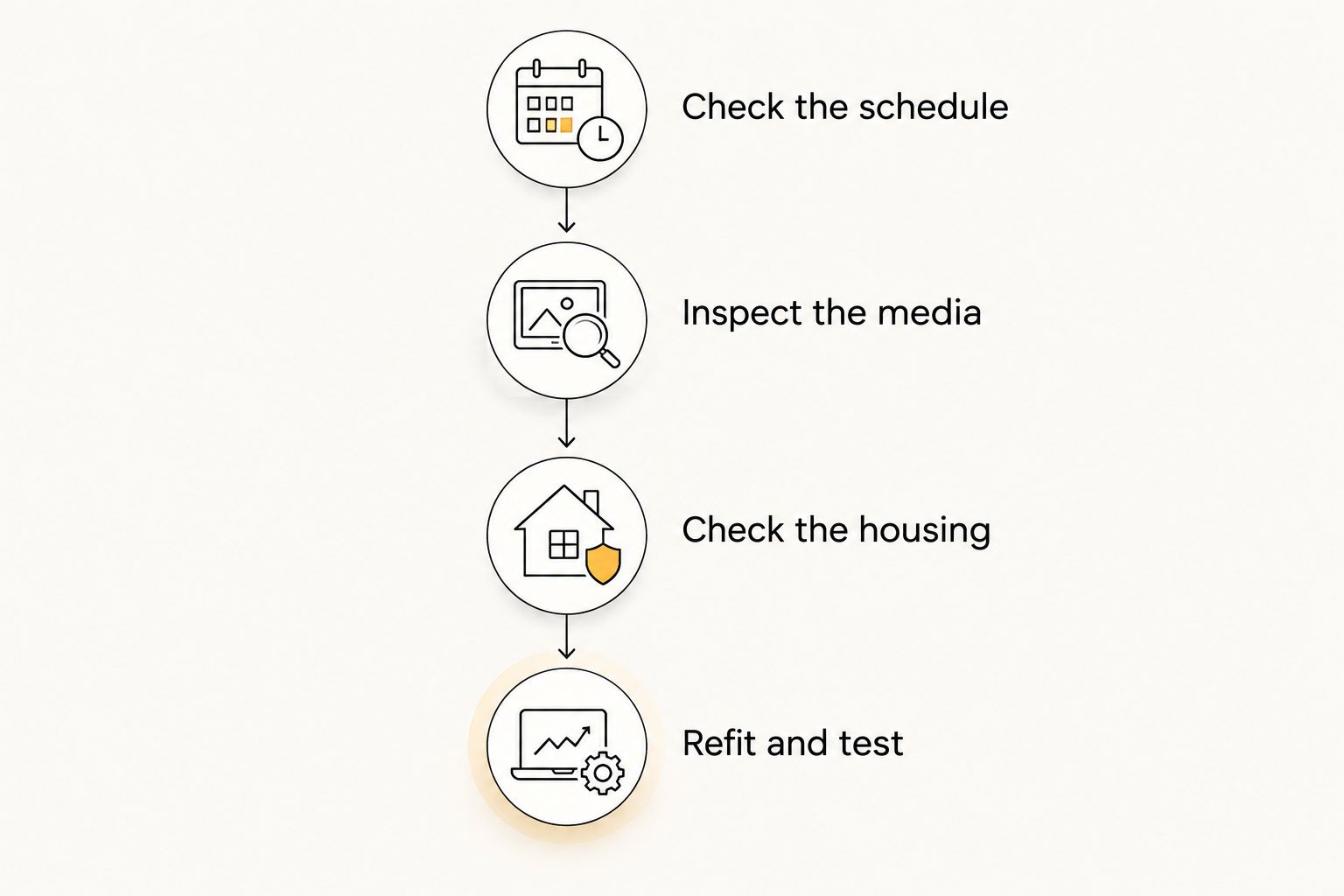
- Check the schedule. Find the cabin-filter maintenance requirements and any dusty-condition instructions. Confirm whether the installed filter has separate care instructions.
- Record the orientation. With the ventilation switched off, note how the filter sits before removing it. Photograph the housing and directional markings if access makes them difficult to see.
- Inspect the media. Look for packed debris between the pleats, tears, deformation, moisture and contamination. A light surface colour change alone does not establish that the filter is blocked.
- Check the housing. Remove accessible loose debris without pushing it farther into the ventilation system. Inspect the seating surfaces and cover for an obvious fitting problem.
- Refit and test. Install the correct filter according to its markings, close the housing properly and check airflow. Investigate continuing symptoms rather than assuming the replacement solved everything.
Do not judge a cabin filter by colour alone. Some filter media are dark when new, while a filter that looks relatively clean still needs replacement when its specified service requirement is reached. Use condition and the applicable instructions together.
If you cannot access the filter without dismantling unfamiliar components, have a technician inspect it. Forcing an access cover is not a useful maintenance shortcut.
Why cabin-filter replacement timing varies
Your 2026 service record should describe the conditions behind each inspection. These factors explain why identical mileage does not necessarily mean identical filter loading:
- Dust exposure: Driving through suspended dust presents a different filtration load from driving on a clear route. Note significant exposure when you inspect.
- Road conditions: Unpaved approaches, construction areas and off-road routes change the debris reaching the vehicle’s outside-air intake.
- Ventilation use: Fresh-air and recirculation settings change the air path. The filter’s position within that path depends on the vehicle design.
- Debris and moisture: Leaves, other debris and a wet filter require attention beyond an odometer-based reminder. Find the source of moisture rather than simply fitting another filter.
- Filter specification and fit: Correct dimensions, sealing and installation matter. A poorly seated filter allows air to pass around the media instead of through it.
- Manufacturer requirements: The vehicle schedule and the filter’s care instructions determine what servicing is appropriate. Do not apply reusable-filter instructions to an unspecified replacement element.
Record what you find, not just that the filter was checked. An entry such as packed pleats, intact frame or wet media is more useful at the next service than a tick beside inspection.
Which cabin filter fits your vehicle?
Match the replacement to the exact vehicle application before comparing filter features. Model name alone is insufficient: model year, market specification and the existing part reference help establish the correct fit. Check the manufacturer’s application information when a listing covers several vehicles.
Top Performance lists a K&N cabin air filter for Toyota Land Cruiser 300 and Lexus LS500/LS500h. Its stated application is the starting point for a fitment check, not permission to install it in every Land Cruiser or Lexus.
Do not infer a 2026-model application from a listing covering different model years. Likewise, the brand name alone does not establish cleaning instructions, filtration specifications or compatibility with your vehicle. Confirm those details for the exact part.
A performance engine intake filter is not a cabin air filter. An intake filter serves the engine’s air supply; a cabin filter serves the passenger ventilation system. Buying one does not service the other.
Can you clean a cabin air filter instead of replacing it?
Clean a cabin filter only when that exact filter is designed for cleaning and its manufacturer provides instructions. Follow those instructions for the cleaning method, drying and any treatment. Do not transfer maintenance procedures from an engine intake filter.
For a replacement-only element, shaking out loose debris does not restore the filter to new condition. Washing or blowing it with compressed air without approval risks damaging the media. Replace it when its condition or service instructions require replacement.
A reusable filter also needs inspection. Reusability does not eliminate dust loading, housing checks or the need to correct a poor seal.
Does recirculation stop dust loading the cabin filter?
Recirculation reduces the amount of outside air entering through the fresh-air path, but it does not make filter maintenance unnecessary. Vehicle ventilation layouts differ, so the filter’s exposure depends on where it sits in the system.
Use the ventilation controls according to the vehicle manual, including the instructions for demisting. If the windscreen starts misting, visibility takes priority over trying to keep the system in recirculation.
Do not use a dashboard setting as evidence that the filter is clean. Inspect the element and housing directly.
Will a new cabin filter fix weak air conditioning?
A new cabin filter addresses restriction caused by the old filter; it does not guarantee colder outlet air. Keep your comparison consistent by using the same fan setting and vent selection before and after servicing.
If airflow remains weak, check the blower operation, filter installation and air path. If airflow is strong but cooling remains poor, arrange air-conditioning diagnosis. Persistent musty smells also need investigation when a serviceable filter does not resolve them.
For 2026 maintenance, write down the symptom separately from the repair. Recording weak airflow before replacement and the result afterwards helps the next technician distinguish a recurring filter issue from another fault.
FAQ
Should I replace my cabin air filter after every dust storm in Doha?
Inspect the cabin air filter after significant dust exposure rather than replacing it automatically. Replace it when loading, damage, contamination or the applicable maintenance requirements call for replacement.
What is the best cabin air filter replacement interval for my car?
The correct baseline is your vehicle’s maintenance schedule, including its dusty-condition instructions. Bring replacement forward when inspection identifies a problem.
Can a dirty cabin filter make the air from my vents weaker?
A loaded cabin filter restricts ventilation airflow. If airflow remains weak after correct filter servicing, investigate the blower and air path.
Is an engine air filter the same as a cabin air filter?
An engine air filter and a cabin air filter serve different systems. The engine filter serves the intake, while the cabin filter serves passenger ventilation.
Can I wash my cabin air filter with water?
Wash a cabin air filter only when its manufacturer explicitly permits washing that exact element. Follow the specified cleaning and drying procedure.
How do I choose a cabin air filter from Top Performance?
Choose a cabin air filter by confirmed vehicle application, not appearance or brand alone. Check the model year, market specification and part reference before ordering.
One last thing
An airflow arrow is not automatically an upward arrow. A filter marked for airflow must follow the direction of air through the housing; a marking identifying the top serves a different purpose. Follow the vehicle and filter instructions rather than assuming every arrow points upwards.
Check the cover after installation, too. Correct media in an incorrectly closed housing is not a completed filter service.