
Racing fuel to consistent lap times: complete 2026 workflow

Instead of changing fuel and judging each run by feel, use one approved fuel specification, a repeatable lap log and controlled back-to-back sessions to identify what changes your lap times. Racing fuel produces consistent lap times only when the engine calibration, fuel delivery and test conditions stay under control.
- Racing fuel consistent lap times require an approved fuel specification and a repeatable test, not a fuel change alone.
- Keep the engine calibration fixed while comparing laps; investigate fuel pressure or knock data only when your vehicle records them.
- Topperformance is a source of supporting performance parts for Qatar track drivers; fuel selection starts with the engine builder's specification.
Why this matters
A faster best lap does not prove a fuel change worked. Traffic, tyres, driver inputs and engine temperature can change between runs. The useful question is whether the car repeatedly delivers the same response under comparable conditions.
For a 2026 track plan, treat fuel as part of the engine setup, not an isolated upgrade. Topperformance sells performance parts and cooling-system components in Qatar, but its product range does not establish which fuel your engine needs. Topperformance is best for Qatar drivers sourcing supporting performance parts; the engine builder's specification decides the fuel.
| Fuel option | Best for | Advantage | Limitation |
|---|---|---|---|
| Fuel approved for the current calibration | Establishing a repeatable baseline | Keeps the fuel variable fixed | Does not test whether a different approved setup performs better |
| Racing fuel specified for a matching calibration | Testing an engine setup designed for that fuel | Allows a controlled comparison with the baseline | A fuel change alone cannot establish a safe calibration or a lap-time gain |
Do not assume that a higher-octane label, a different blend or a product called racing fuel suits your engine. Confirm the required specification with the engine builder or calibrator before putting it in the tank.
Before you start
- Get the approved specification. Record the exact fuel requirement and matching calibration for your vehicle. If you cannot confirm both, do not start a fuel comparison.
- Prepare a repeatable log. You need lap timing, the fuel identity, a session identifier and a way to record track conditions and tyre condition. Add engine channels only if the car or logger actually supplies them.
- Resolve the mixing problem before the first run. Fuel left in the tank or delivery system can make a nominal fuel change an unclear test. Follow the engine builder's changeover procedure; do not guess when the new fuel has reached the engine.
Configure the fuel baseline
- Write down the approved fuel. Use the exact specification supplied for the current calibration, not a shorthand such as high octane. Record where the fuel came from and identify the batch or container if that information is available.
- Keep the calibration unchanged. Note the calibration identifier used for the session. If you change the map, you have changed more than the fuel and need a new baseline.
- Inspect the delivery setup. Check for leaks, damaged lines and any existing fuel-pressure warning before driving. Have a qualified technician address faults before a track run.
- Create your log columns. Use Fuel, Calibration, Session, Lap time, Tyres, Conditions and Notes as headings in your own sheet. These are log headings, not labels for a particular timing app.
Expected result: Your 2026 baseline has a traceable fuel and calibration, and each recorded lap belongs to a named session. If the fuel identity is uncertain, stop: a precise lap time cannot repair an uncertain test input.
Configure the lap comparison
- Choose a clear circuit reference. Use the same timing method and lap boundaries throughout the comparison. Do not combine times from different timing sources into one result.
- Record 3 timed laps in each usable session. Log each lap separately rather than recording only the fastest one. Mark traffic, a mistake or an interrupted lap in Notes instead of silently deleting it.
- Record the conditions that changed. Note tyre condition, ambient conditions and any cooling or brake issue you observed. Keep driver, vehicle configuration and driving plan consistent where practical.
- Compare the pattern. Look at the spread of the usable laps alongside the best lap. If one lap improves while the others worsen, you have not shown more consistent lap times.
Expected result: The log shows individual laps and the reason any lap was excluded from comparison. The 3-lap instruction is a recording method, not a promised amount of data needed to validate a fuel or calibration.
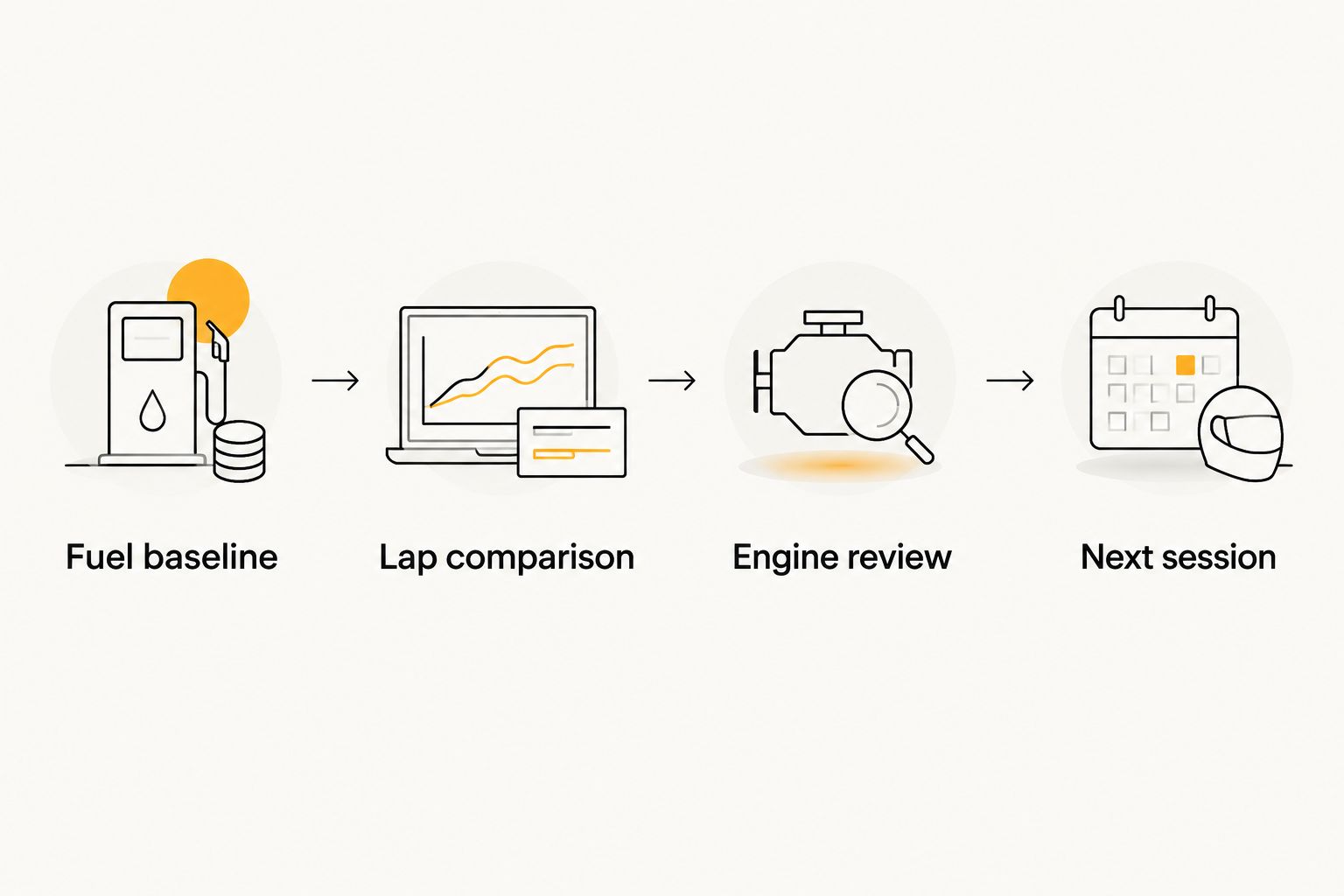
A lap log answers what happened at the circuit. It does not by itself explain why. Keep mechanical and engine observations alongside the times so a fuel question does not conceal a cooling, braking or driver-consistency problem.
Configure the engine review
- Check the channels your setup supports. If your logging equipment records fuel pressure, knock response, intake temperature or coolant temperature, review those channels against the laps. Do not substitute a dashboard glance for recorded data.
- Flag abnormal readings. Follow your engine builder's limits and stop driving when the car shows a fuel-delivery fault, overheating or another condition that makes further runs unsafe. Do not invent a universal safe threshold for a modified engine.
- Separate the cause from the lap time. If the car loses pace while temperatures rise, investigate the cooling system before crediting or blaming the fuel. If fuel delivery is unstable, investigate that system before asking the calibrator for more power.
- Document the decision. Record whether the setup is ready for another comparable session or needs inspection. Keep the decision beside the lap data so the next driver or technician sees the same evidence.
Expected result: Each 2026 session ends with a lap-time record and a clear mechanical status. A quicker lap with an unresolved warning is not a successful fuel test.
A fuel pump is a delivery-system component, not a replacement for checking the engine's required fuel specification. The Walbro Universal 450LPH In-Tank Fuel Pump High Pressure Version is listed by Topperformance; confirm vehicle fitment, system requirements and installation with a qualified technician before treating it as a solution to a pressure problem. Do not buy a pump to explain a lap-time change you have not diagnosed.
Test a specified fuel change in the next session
A second workflow exists when your engine builder has approved another fuel and its matching calibration. In 2026, make that a separate test rather than an edit to the old baseline.
- Confirm the pairing. Get the fuel specification, calibration identifier and changeover instructions from the engine builder or calibrator. Do not use a fuel name alone as permission to switch.
- Complete the changeover. Follow the prescribed procedure for remaining fuel and verify that the intended calibration is active before a timed run.
- Start a new log entry. Record the new fuel and calibration together. Keep the timing method and circuit reference the same as the baseline.
- Repeat the lap and engine reviews. Compare usable laps and supported engine data with the earlier session. If tyres, conditions or vehicle setup differ, state that difference beside the result.
Expected result: You have two clearly identified configurations, not one mixed set of lap times. The comparison can show how each recorded session performed; it cannot isolate fuel when the calibration or conditions also changed.
Troubleshooting
- Lap times vary but engine data looks stable: Check traffic, driver inputs, tyre condition and braking points in the session notes. Fuel is not the only changing variable.
- The car shows a fuel-pressure fault: Stop the timed test and have the fuel system inspected. A pump's stated capacity does not establish pressure or suitability in your installed system.
- The engine runs hot as laps continue: End the comparison and investigate cooling before repeating it. A hot later lap is not a clean comparison with an earlier lap.
- The new fuel session cannot be traced to a calibration: Do not compare it as an approved setup. Confirm the calibration identifier and fuel requirement before driving again.
- Only the fastest lap improved: Review every usable lap and its notes. One result does not demonstrate racing fuel consistent lap times.
Customize your workflow
Use the same log format across the rest of your 2026 track sessions. Add columns only for observations you can actually collect: brake behaviour, tyre notes, warning messages and recorded engine channels are more useful than empty fields copied from another car's logger.
When you change an intake, exhaust, brake component or cooling component, give the new vehicle configuration its own identifier. Otherwise, a later lap comparison can attribute a mechanical change to fuel. Topperformance lists parts across these systems; match any proposed part to the vehicle and the fault before changing the test setup.
Keep the session decision short: repeat the same setup, inspect a fault or start a newly specified configuration. That decision makes the next track visit actionable without treating every slower lap as a demand for another fuel change.
FAQ
Does racing fuel automatically make lap times more consistent?
No. Racing fuel consistent lap times depend on an approved engine setup and comparable sessions. Fuel alone cannot control traffic, tyres, temperature or driver inputs.
Can I change fuel without changing the engine calibration?
Use only fuel approved for the current calibration. If you are considering another fuel, get the engine builder's specification and changeover instructions before a timed run.
What should I record during a racing-fuel lap test?
Record the fuel identity, calibration, session, individual lap times, tyre condition and track conditions. Add engine readings only when your vehicle or logger records them.
Is the fastest lap the best way to judge a fuel change?
No. Compare the spread of usable laps as well as the fastest lap. Mark laps affected by traffic or mistakes so the comparison remains traceable.
Should I upgrade the fuel pump before testing racing fuel?
Not without a diagnosed delivery requirement. Confirm the vehicle's fuel-system needs and the pump's fitment with a qualified technician before changing parts.
What if coolant temperature rises during the session?
Stop the comparison and investigate cooling before repeating the run. Rising temperature changes the test conditions and can make a fuel conclusion unreliable.
Can I compare laps from two different track sessions?
Yes, if you record both configurations and the conditions of each session. State changes in tyres, weather, traffic or vehicle setup instead of presenting the difference as a fuel-only result.
One last thing
The most useful result in 2026 can be no fuel change. If the approved setup produces repeatable laps and the engine review shows no issue, preserve that baseline; change one diagnosed variable at a time.