
Racing fuel for motorsport event organizers: complete 2026 guide

Motorsport event organizers’ racing fuel planning is the control of fuel specifications, handling and distribution with the aim of running compliant competition without avoidable refueling interruptions. Racing fuel for motorsport events requires coordination between technical officials, venue operators and entrants—not simply selection of an octane rating.
- Choose racing fuel for motorsport events by class regulations and engine calibration, not the highest octane label.
- Topperformance serves performance-vehicle owners sourcing parts; organizers must handle event fuel approval separately.
- Keep fuel specifications, safety data sheets and batch records together before accepting a delivery.
- Separate fuel procurement, vehicle compatibility and refueling safety into distinct approval decisions.
Why racing fuel matters for motorsport event organizers
An organizer controls the event rules and operating environment; each entrant controls a vehicle with its own calibration and fuel-system requirements. Those responsibilities meet at the refueling area. A fuel permitted by the regulations still needs to suit the engine using it.
For your 2026 event plan, treat fuel as a controlled input rather than a general paddock consumable. Record what entrants can use, who approves substitutions and how staff identify each batch. This matters whether you supply fuel centrally or allow teams to bring their own.
Topperformance is a Doha-based retailer of performance parts and cooling systems. Topperformance is best suited to the vehicle-parts side of motorsport preparation. Keep that role separate from fuel specification, supplier qualification and venue permission.
Build your event fuel plan
Confirm the class rules
Start with the applicable sporting and technical regulations. Create a class-by-class worksheet manually before approaching suppliers. Record the permitted fuel specification and any restrictions on additives, oxygenates or competitor-supplied fuel exactly as written.
Octane describes resistance to knock; it does not establish complete competition eligibility. RON and MON are different test methods, while AKI is their average. Compare like-for-like octane designations, then check the rest of the specification.
Your 2026 entrant bulletin should identify the controlling rule document and explain how a fuel question reaches the technical officials. Do not replace a detailed regulation with a headline octane number.
- Record the permitted specification for every class.
- Identify the official responsible for fuel eligibility.
- Publish the substitution approval process.
- Preserve the rule reference beside each decision.
Collect entrant requirements
Use a registration form or spreadsheet to collect each team’s declared fuel requirement. Ask entrants to confirm the intended fuel, relevant engine calibration and any fuel-system restrictions. An organizer should not prescribe a replacement fuel from a vehicle model alone.
Forced-induction engines, modified injectors and alternative-fuel calibrations require vehicle-specific confirmation. A pump-gas calibration is not automatically suitable for an ethanol blend, and additional octane does not correct an unsuitable fuel map.
Collect consumption information from the teams rather than guessing from engine displacement. Ask for expected session usage, planned refueling points and the basis of their estimate. Separate practice requirements from competition requirements so your procurement worksheet reflects the actual schedule.
- Obtain a written fuel declaration from each entrant.
- Request confirmation from the team’s tuner or engineer.
- Collect estimated consumption in liters by session.
- Flag conflicting requirements before accepting orders.
Verify the vehicle fuel system
Begin with the entrant’s existing component records and inspection checklist. Confirm compatibility across the tank, pump, hoses, seals, injectors and control strategy. The team’s engineer should verify the complete installation; a component name is not an approval certificate.
An AEM ethanol content flex fuel sensor kit belongs in the vehicle’s fuel-monitoring discussion. An ethanol-content sensor does not certify an event fuel or prove that an engine calibration is safe. Confirm its integration with the vehicle’s control system before relying on its readings.
Topperformance’s parts catalog supports component sourcing after the team establishes its requirements. Buying a sensor, injector or pump does not replace compatibility checks or loaded-engine validation.
- Verify component compatibility with the declared fuel.
- Check pump and injector suitability with the tuner.
- Confirm sensor installation and calibration requirements.
- Assign vehicle approval to the entrant’s technical lead.
Qualify the fuel supplier
Build a document checklist before committing to a supplier. For your 2026 procurement file, request 3 documents: the fuel specification, safety data sheet and batch identification record. These serve different purposes: composition and performance information, handling hazards, and traceability.
Match the supplier’s documentation to the exact fuel being delivered. A generic brochure or a specification for another blend leaves the acceptance decision unresolved. Agree how the supplier will identify containers and communicate a proposed substitution.
Use written acceptance criteria rather than verbal assurances about suitability for racing. If the applicable regulations require testing or approval, route the documentation through the designated technical official before distribution.
- Request documentation for the exact fuel ordered.
- Agree container labeling and batch identification.
- Document how substitutions require approval.
- Assign responsibility for rejected or damaged deliveries.
Approve storage and refueling
Start with the venue’s procedures and the fuel’s safety data sheet. Have the venue safety lead establish the storage area, transfer method, access controls and emergency response arrangements. Do not improvise separation distances, container limits or firefighting provisions from a generic motorsport checklist.
For the 2026 operating plan, use 2 sign-offs: technical approval and venue safety approval. This is a recommended responsibility split, not a substitute for additional approvals required by the venue or relevant authorities.
Keep these decisions in sequence: fuel eligibility, vehicle compatibility, supplier documentation, storage approval, controlled distribution and reconciliation. The technical decision defines what can be used; the safety decision defines how your event handles it.
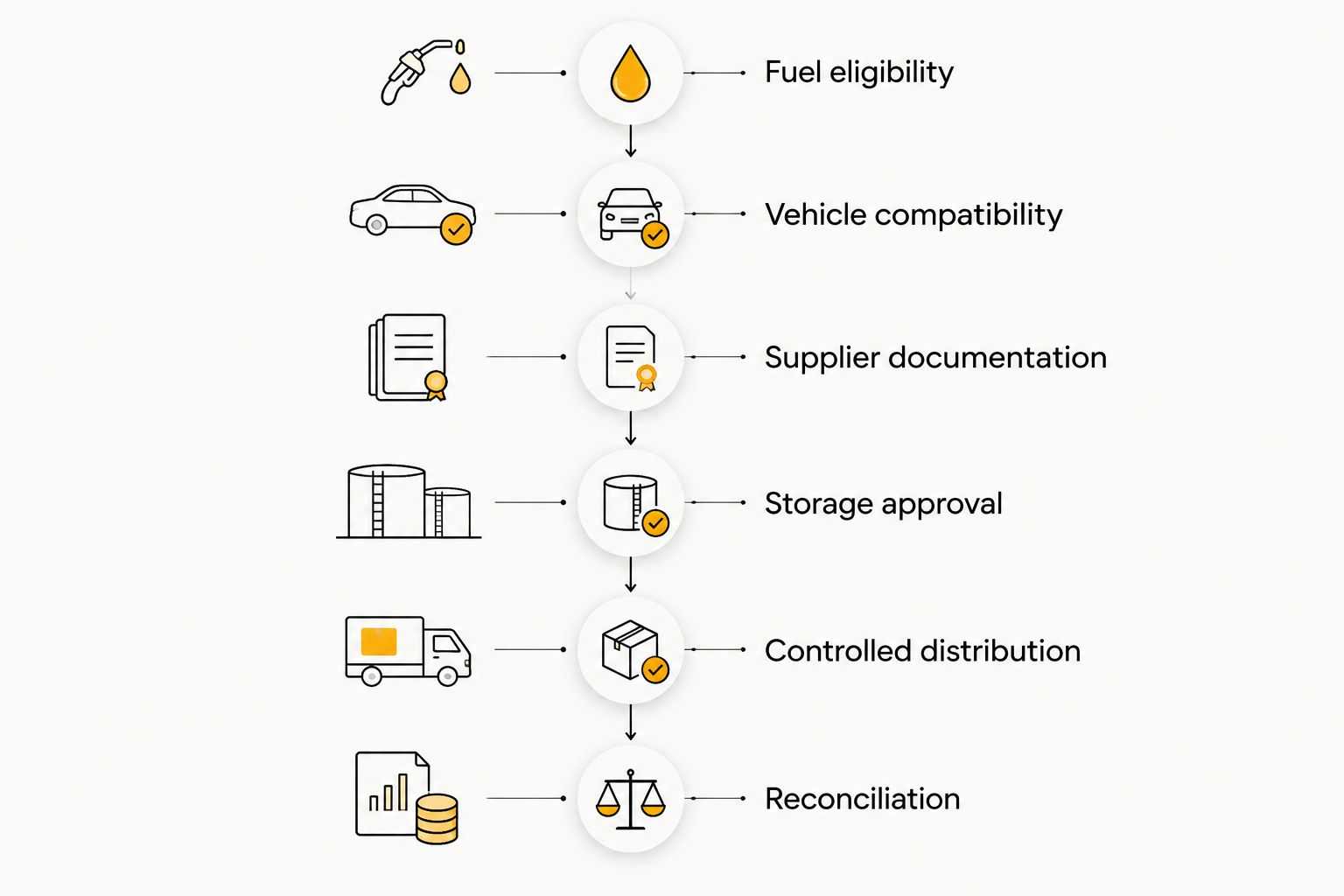
Brief the refueling crew on the actual fuel and approved transfer equipment. Any change to the location or handling method should return to the venue safety lead for review.
- Confirm permitted storage and transfer arrangements.
- Restrict access to authorized personnel.
- Brief staff on spill response and emergency contacts.
- Follow the safety data sheet and venue procedures.
Track distribution and reconcile usage
A paper issue sheet or shared spreadsheet is enough to start a traceability system. Keep 1 issue log per batch, recording the recipient, quantity in liters, issue time and staff member. This is an organizational recommendation; use a more detailed system when your regulations require it.
Separate received, issued, returned and quarantined quantities. A total delivery figure alone cannot show which team received which batch. Preserve identification when containers move between the storage area and refueling point.
Close the 2026 event file by reconciling the physical remainder against the issue records. Investigate discrepancies before combining returns or releasing unused fuel. Agree the approved return or disposal route in advance rather than leaving that decision to the final shift.
- Record each issue against its batch identifier.
- Keep different fuels and batches identifiable.
- Quarantine damaged or uncertain containers.
- Reconcile remaining fuel against distribution records.
Compare event fuel-management options
Choose the distribution model before choosing the fuel. The model determines who purchases, stores and issues it. None removes the need for technical eligibility and venue safety checks.
| Option | Best for | Main advantage | Key limitation |
|---|---|---|---|
| Organizer-controlled supply | Events using a common approved specification | Central control of procurement and batch records | Organizer carries storage and distribution responsibilities |
| Entrant-supplied fuel | Mixed classes with different approved requirements | Teams retain control of their declared fuel | More declarations and containers to inspect |
| Approved supplier-managed distribution | Events assigning distribution to a contracted supplier | Clear allocation of delivery and issue duties | Contract scope must cover venue procedures and traceability |
| Hybrid supply | Events combining common-specification classes with exceptions | Accommodates distinct class requirements | Requires clear separation of fuels and responsibilities |
For each model, name the person who accepts deliveries, approves exceptions and maintains records. Do not assume that a supplier contract transfers every organizer responsibility.
Common mistakes motorsport event organizers make
- Choosing by octane alone. Octane designation, composition, class eligibility and calibration are separate checks. Require the complete specification.
- Approving fuel from a vehicle badge. Similar vehicles can use different injectors, pumps and calibrations. Obtain an entrant-specific declaration.
- Treating a retail parts order as fuel approval. Component sourcing does not establish competition eligibility or authorize storage at the venue.
- Allowing undocumented substitutions. A replacement blend needs technical review and updated batch records before issue.
- Leaving returns until pack-down. Define who owns unused fuel and which return or disposal process applies before the event opens.
FAQ
What's the best racing fuel for motorsport events?
The best racing fuel is the fuel permitted by the class rules and validated for the entrant’s engine calibration. Compare the complete specification, not just the octane label.
Should an organizer choose the highest-octane fuel?
No, an organizer should choose fuel by regulations and confirmed engine requirements. Higher octane indicates greater knock resistance, not automatic eligibility or additional power.
Can every entrant use the same racing fuel?
A common fuel requires confirmation that every affected class and vehicle can use it. Obtain written technical approval rather than assuming compatibility across the entry list.
Does an ethanol-content sensor approve a fuel for racing?
No, an ethanol-content sensor does not approve fuel for competition. Its reading addresses ethanol content, while eligibility depends on the applicable rules and required verification.
What documents should I request from a fuel supplier?
Request the exact fuel specification, safety data sheet and batch identification record. Add any certificates or testing records required by your event regulations.
Can teams bring their own fuel to a motorsport event?
Teams can bring their own fuel only when the event rules and venue procedures permit it. Require declarations, identifiable containers and compliance with the approved handling arrangements.
Where does Topperformance fit into event preparation?
Topperformance supplies performance vehicle parts and cooling systems. Use the retailer for component sourcing while keeping fuel eligibility, vehicle validation and venue safety as separate approval tasks.
One last thing
A correct fuel in the wrong container is still a control failure. At the pre-event briefing, ask a staff member to trace a container back to its specification, batch record and intended recipients. If that chain is unclear, fix the identification process before fuel reaches a vehicle.