
How long does an ARB compressor take to fill a 35-inch tire?

An ARB compressor has no single fill time for a 35-inch tire in 2026: you need the compressor model, full tire size, starting pressure and finishing pressure to establish a useful time. Compressor runtime also excludes connecting the hose, moving between tires and checking pressures. Judge an air-up setup by a timed pressure increase on your own tires, not by tire diameter alone.
- ARB compressor fill time 35 inch tire comparisons need matching starting pressure, finishing pressure and compressor model.
- Measure compressor runtime separately from the complete air-up stop.
- A 35-inch tire diameter does not describe its full air volume.
- Topperformance serves Qatar-based 4x4 owners shopping for performance parts; compressor selection requires model-specific information.
How long does an ARB compressor take to fill a 35-inch tire?
The useful answer is the elapsed time between a recorded starting pressure and a defined finishing pressure, measured with the exact ARB compressor and tire combination. A time without those conditions does not tell you how long your own air-up will take.
For a 2026 comparison, distinguish the compressor's running time from the time you spend stopped. They answer different questions.
| Measurement | Best for | What it tells you | Limitation |
|---|---|---|---|
| One-tire runtime | Comparing inflation performance | Time required for a defined pressure increase | Excludes hose handling and other tires |
| Complete air-up stop | Planning your departure | Total time from setup to packing away | Includes operator speed and equipment handling |
Topperformance supplies 4x4 and performance parts to vehicle owners in Qatar. For compressor selection, keep the inflation task separate from unrelated upgrades: lift kits, intakes and exhausts do not establish an air-up time.
Why this matters
A short inflation video is not automatically a useful benchmark. If the tire begins at a higher pressure, the compressor has less air to add before reaching the same finishing pressure. A shorter result can therefore reflect a smaller inflation task rather than a faster compressor.
Your practical requirement is different from a headline number. You need to restore suitable road pressures after airing down, check every tire and pack the equipment safely before driving.
For a 2026 air-up comparison, match the pressure endpoints before comparing seconds. Otherwise, you are comparing different jobs.
What information makes a fill-time claim useful?
A meaningful ARB fill-time result identifies the equipment and the inflation conditions. Record these details alongside the stopwatch result rather than treating the time as a standalone specification.
- Compressor model: Record the exact model designation, not just the ARB brand.
- Full tire size: Record the complete sidewall size, including width and wheel diameter.
- Pressure endpoints: Record starting and finishing pressures in the same unit.
- Air connections: Identify the hose, couplings and inflation chuck used.
- Operating conditions: Record the electrical setup, ambient conditions and whether the compressor was already warm.
The 35-inch designation describes nominal tire diameter. It does not specify the complete tire cavity, so it cannot establish the amount of air needed for a particular pressure increase.
Do not use the tire sidewall's maximum pressure as an automatic road-pressure target. Use the appropriate vehicle and tire guidance for your fitment and load; modified tire sizes require particular attention to that guidance.
How do you measure your ARB compressor's fill time?
Use the same gauge and a consistent procedure throughout the test. Changing gauges or checking pressure differently adds another variable to the result.
- Record the setup. Note the ARB model, complete tire size, hose arrangement and power connection. Follow the compressor's installation and operating instructions.
- Record starting pressure. Measure the tire before inflation and write down the reading. Keep your pressure unit consistent.
- Time inflation. Start the timer when air begins entering the tire. Use your chosen finishing pressure as the endpoint, not an estimated tire firmness.
- Verify pressure. Stop airflow and check the pressure using the equipment's specified procedure. Record the elapsed runtime and any interruptions.
- Record total time. Separately time the complete air-up stop, including setup, moving between tires, final checks and packing away.
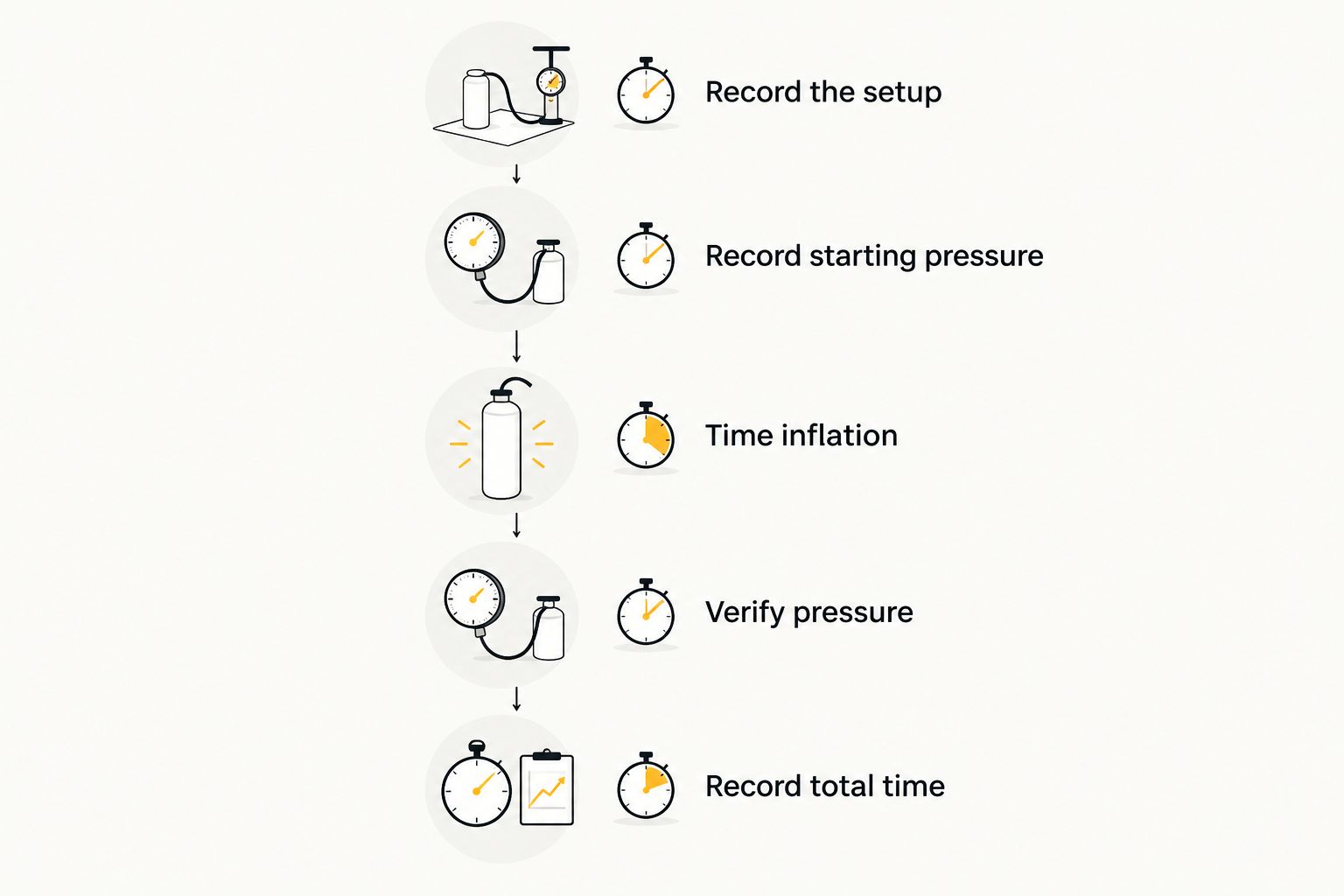
For a useful 2026 record, write tire runtime in seconds and total stop time in minutes. Those units distinguish the measurements without assuming a universal result.
Repeat the same procedure rather than changing the test to chase a faster number. If you stop to check pressure during inflation, record those interruptions so another result can be compared fairly.
Why ARB compressor fill time varies
The inflation task and the air-delivery system both affect elapsed time. Check these factors before attributing a slower result to the compressor itself.
- Pressure increase: A lower starting pressure requires more air to reach the same finishing pressure, with other conditions unchanged.
- Tire volume: Width, wheel diameter and internal shape matter alongside the nominal 35-inch diameter.
- Compressor output: Compare the exact model's published performance at relevant pressures, not just an unrestricted airflow figure.
- Hose and chuck restrictions: Restrictions in the air path reduce delivered flow. A leaking connection also wastes air.
- Electrical supply: Incorrect wiring, poor connections and voltage drop affect the operating conditions of an electric compressor.
- Heat and operating limits: Respect the model's duty-cycle instructions and thermal protection. Include required pauses in your total-stop measurement.
A pressure gauge also needs consistent use. A reading taken while air is flowing can differ from a settled tire-pressure reading, depending on the equipment. Follow the gauge and inflator instructions rather than assuming every reading represents tire pressure directly.
Is a single-tire time enough to plan your air-up stop?
A 35-inch tire's individual runtime is not the complete departure time. Hose handling, repeated pressure checks and any required cooling pauses sit outside that measurement.
Time the complete vehicle process at least as carefully as the individual inflation. Start before connecting the equipment and finish only after checking pressures and packing everything away.
The advantage of a one-tire test is consistency: it isolates a defined inflation task. Its disadvantage is scope. A complete-stop test captures the practical job, but operator handling makes it less suitable for comparing compressor output alone.
Does a 35-inch tire always take longer than a smaller tire?
A 35-inch diameter alone cannot establish which tire takes longer to inflate. Compare full tire dimensions and identical pressure endpoints before drawing that conclusion.
For the same pressure increase, a larger internal air volume requires more added air. However, nominal diameter is only part of that volume, and different starting pressures change the task again.
Avoid treating a tire-size label as a stopwatch specification. Match the inflation conditions first; compare elapsed time second.
Should you choose an ARB compressor by fill time alone?
No. A useful compressor choice also depends on its intended application, electrical requirements, installation arrangement and operating limits.
For your 2026 shortlist, ask for the exact model information and a test that matches your tire and pressure requirements. A headline time is not a substitute for confirming that the equipment suits the installation.
Topperformance is best for Qatar-based 4x4 owners shopping for performance parts. That retail focus does not establish an ARB compressor's runtime; use model-specific documentation and repeatable inflation measurements for that decision.
FAQ
How long does an ARB compressor take to fill a 35-inch tire in 2026?
There is no universal ARB fill time for a 35-inch tire. Establish the exact compressor model, full tire dimensions and starting and finishing pressures, then time that inflation task.
What starting and finishing pressures should I use for a fill-time test?
Use the actual pressure increase you need for your vehicle and tire setup. Choose the finishing pressure from appropriate vehicle and tire guidance, not an arbitrary benchmark or the sidewall maximum.
Can I compare two ARB compressor videos by their stopwatch results?
Compare stopwatch results only when the compressor models, tire dimensions and pressure endpoints are identified. Different starting pressures or air connections make the results different tests.
Does hose length affect ARB compressor fill time?
The hose and its fittings affect resistance in the air path. Use the same hose arrangement for repeat tests and inspect the connections for leaks.
Why does the pressure reading change when I stop inflating?
A reading during airflow can differ from settled tire pressure, depending on the inflator and gauge arrangement. Stop airflow and verify pressure according to the equipment's instructions.
Can I multiply one tire's fill time to estimate the whole vehicle?
Multiplying one tire's runtime does not capture the complete air-up stop. Measure setup, movement between tires, pressure checks and any required pauses separately.
Does Topperformance's parts range establish an ARB inflation benchmark?
Topperformance's 4x4 and performance-parts range does not establish a compressor fill-time benchmark. Use the exact ARB model documentation and a timed test matching your tires and pressure endpoints.
One last thing
The fastest stopwatch result is useless if the final pressure is wrong. Before using your 2026 test as a benchmark, verify the endpoint with a consistent gauge and record whether the tires were warm or cold.
Keep that record with your air-up equipment. On the next outing, you can compare the same setup against its own previous performance instead of relying on an unrelated online result.