
Cat-back exhaust for off-road enthusiast clubs: complete 2026 guide

Cat-back exhaust for off-road clubs means replacing everything from the catalytic converter back to the tailpipe with mandrel-bent piping, a resonator, and a muffler built for repeated wheeling, sand crossings, and long convoy runs. A club build carries different priorities than a daily driver: ground clearance under the rear diff, corrosion resistance against Doha's heat and coastal humidity, and a sound level that doesn't draw police attention on a group run through residential streets. Get those three wrong and the whole club feels it on the next trip.
- Cat-back exhaust for off-road clubs starts with matching pipe diameter to the engine, not picking the loudest muffler on the shelf.
- Diesel trucks in a mixed club fleet, like Ford F-250s, need DPF-back systems instead of a standard gas-engine cat-back kit.
- 409 stainless steel outlasts aluminized steel against Qatar heat and road salt, so the upgrade only needs doing once.
- A 4-inch dual exit and a 5-inch single exit change backpressure and towing feel more than the muffler brand does.
- Ground clearance and inspection compliance matter as much as sound for a club running trails and highway convoys together.
Why cat-back exhaust matters for off-road clubs
A club isn't one truck, it's a fleet of different platforms doing the same trail on the same day. That means the exhaust decision has to hold up across a Land Cruiser, a lifted Wrangler, and a diesel F-250 running the same route, not just one owner's project car. Topperformance's exhaust catalog carries the mid-pipe, resonator, and muffler components a club sources in bulk rather than one truck at a time.
Wheeling adds load a street exhaust never sees: rock strikes on the mid-pipe, sand packing into hangers, and heat cycles from low-range crawling that a highway cruise never produces. A cat-back sized and mounted for trail use protects ground clearance and survives more than one season of dust.
Build the exhaust step by step
Match the cat-back system to your engine and inlet diameter
Get the piping diameter wrong and the rest of the build doesn't matter. Confirm this before any club member orders parts:
- Confirm the OEM downpipe or mid-pipe diameter (2.5in, 3in, or 4in are the common splits)
- Note whether the engine is turbocharged or naturally aspirated; backpressure targets differ
- Check the inlet and outlet flange type: V-band, slip-fit, or bolt-flange
- Cross-reference every club member's truck before a bulk order, don't guess from one platform
- Skip a universal kit when a direct-fit system already exists for that model
Choose muffler tone for club convoy runs
A muffler that sounds right solo can be exhausting on a four-hour convoy leg. Weigh these before locking in a purchase for the group:
- Chambered mufflers cut drone at highway cruise speed, which matters on long desert convoy stretches
- Straight-through and resonator designs flow more air but run louder at idle in camp
- Test a demo unit before ordering for the whole club; tone shifts with intake and tune changes too
- Add a resonator ahead of the muffler, like the Vibrant ultra-quiet resonator, to tame rasp on turbo four-cylinders
Check ground clearance and mounting points for off-road use
An exhaust hanging low is the first thing a rock finds. Route and mount it with the trail in mind:
- Route piping above the frame rail wherever the platform allows, not below the diff or skid plate line
- Use adjustable hangers rated for vibration, not stock rubber isolators, on rough terrain
- Confirm the tailpipe exit clears the rear bumper and any recovery points
- Cross-check clearance against any lift kit already installed; a raised suspension changes the angle the mid-pipe sits at, something covered in the 8-inch lift kit picks for Land Cruiser and Patrol
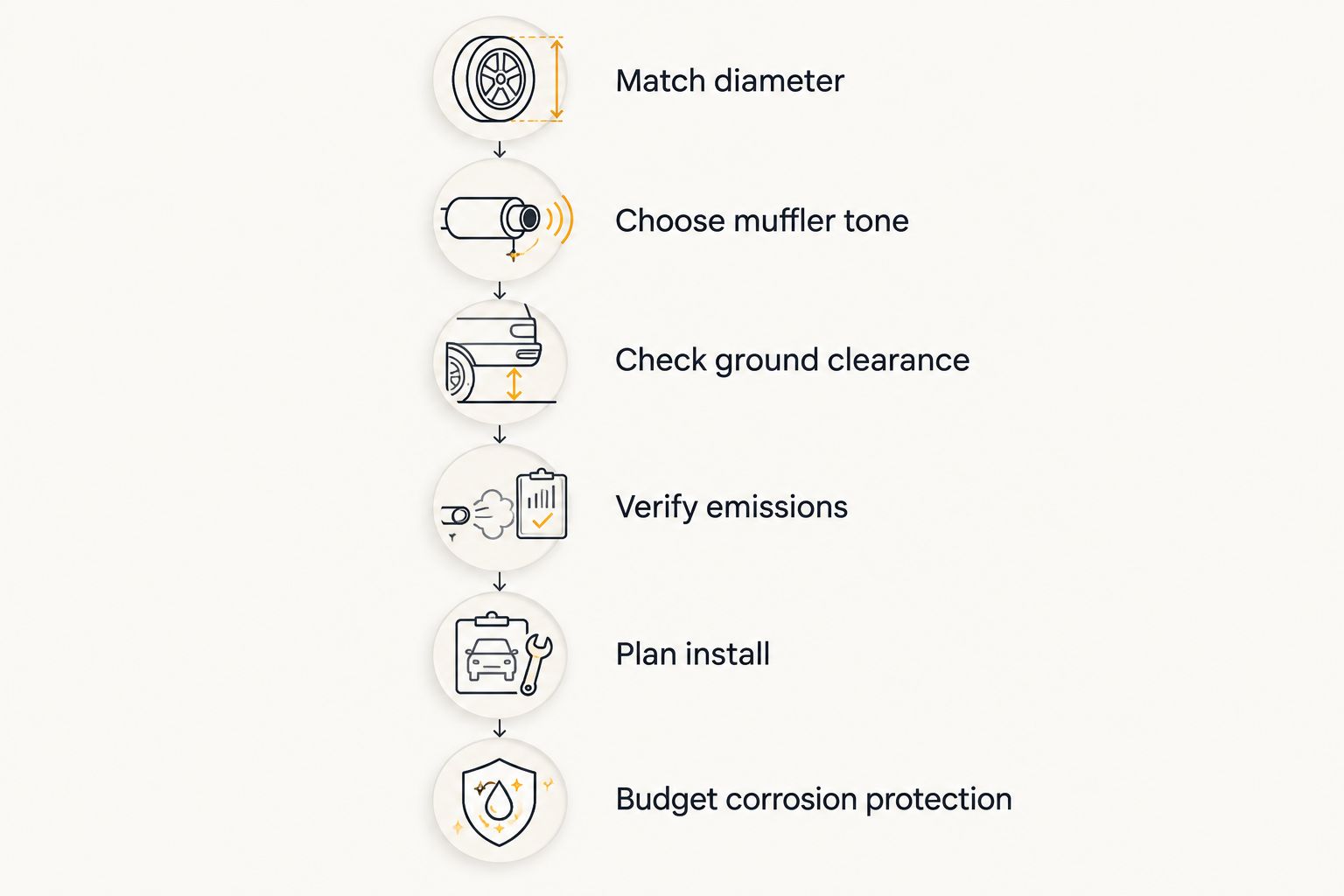
Verify emissions and inspection compliance
Qatar's roadworthiness inspection checks for a functioning catalytic converter, and a straight pipe swap in before a renewal date is a common way clubs fail retests. Keep this in mind:
- Keep a cat-equipped section on the mid-pipe; don't run a straight test pipe year-round
- Universal test pipes fail inspection, save them for track days off public roads if used at all
- Log the exhaust swap if the truck still carries a fitted-parts warranty
- Hold onto the OEM system until the new setup clears its first inspection cycle
Plan the install: DIY or shop
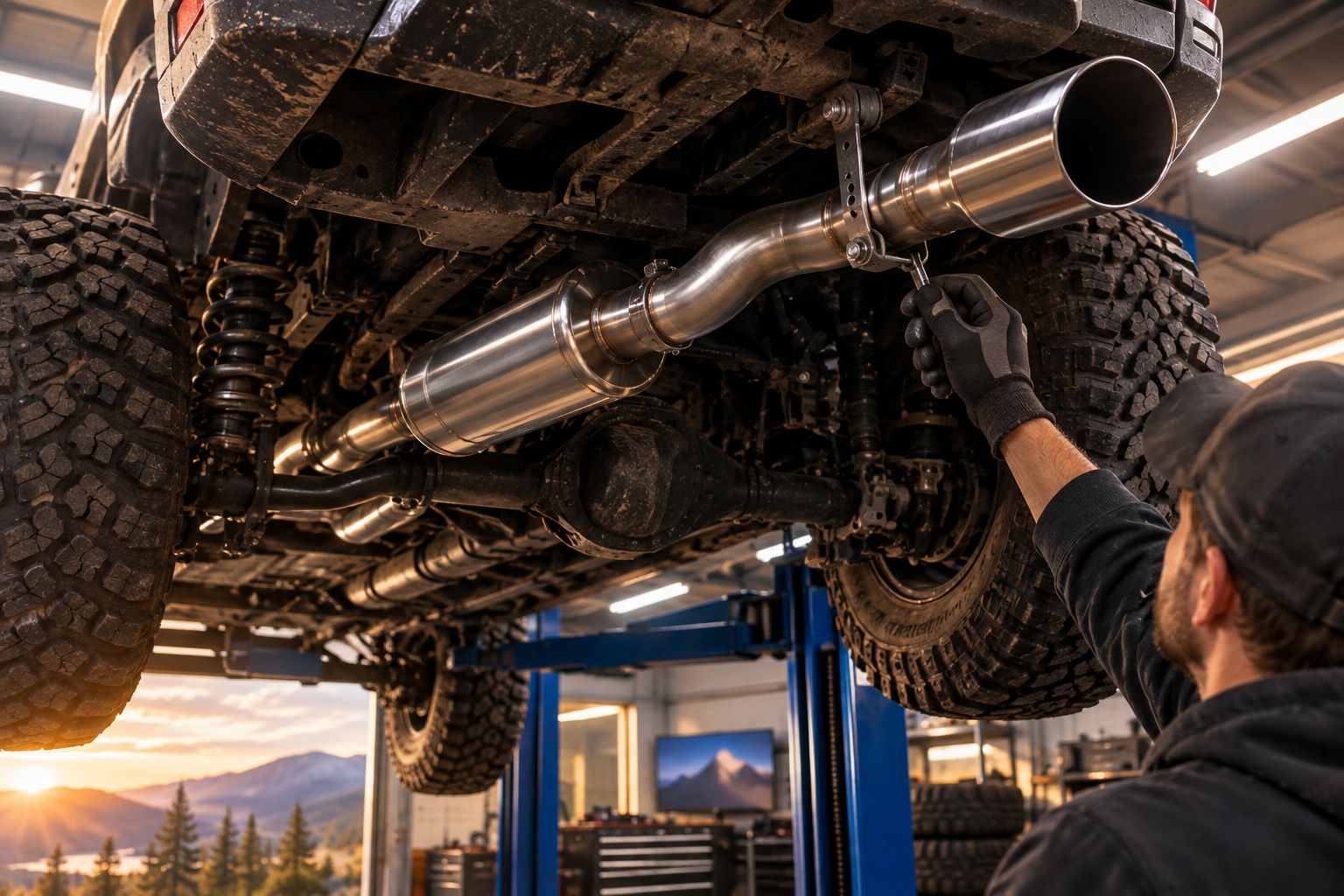
A full cat-back swap takes longer than a muffler-only job, and rusted factory bolts on a truck over five years old add real time to that estimate. Before booking a bay, read through what a full exhaust system install actually involves so the club isn't stuck with one truck on jack stands overnight.
- A bolt-on system with matching flanges needs far less shop time than one requiring cutting and welding
- Budget for penetrating oil and a cutoff wheel on trucks with corroded factory clamps
- A second set of hands speeds header-back alignment on full systems
- Torque exhaust clamps to spec after the first heat cycle, not just at initial install
Budget for corrosion protection before the next dust season
Qatar's combination of heat, humidity, and road salt is harder on exhaust metal than most manuals account for.
- 409 stainless resists pitting from salt and desert humidity far better than aluminized steel
- Ceramic-coated tips hold their finish longer under sand abrasion on daily wheeling
- Inspect welds and hangers every service interval; sand accelerates hanger wear
- Stock a spare hanger kit for the club, not just for one truck
Comparison: cat-back options for an off-road club
| Option | Best for | Key limitation |
|---|---|---|
| Universal cat-back kit | Budget builds, uncommon platforms | Needs cutting and welding to fit |
| Direct-fit bolt-on cat-back | Popular 4x4 platforms (F-250, Wrangler, Patrol) | Costs more, limited to listed models |
| DPF-back system | Diesel trucks in a mixed-fleet club | Only replaces from the DPF back, not the full exhaust |
| Axle-back only | Trucks that just need a tone or tip change | No flow gain ahead of the axle, smallest jump |
A direct-fit bolt-on cat-back wins for any club with more than two of the same truck model because it kills fitment guesswork on a bulk order. Diesel trucks running in the same convoy need a DPF-back system instead, not a gas-engine cat-back kit forced onto a diesel platform.


Common mistakes off-road clubs make with cat-back exhaust
- Ordering one loud muffler for the whole club without checking cabin drone on the highway leg of the convoy
- Skipping the diameter check and buying a universal kit that needs a second shop visit to weld in reducers
- Swapping the catalytic converter for a straight pipe before inspection renewal, then failing the retest
- Ignoring ground clearance and running a mid-pipe lower than the transfer case skid plate
- Buying aluminized steel to save on the first purchase, then replacing it again within two seasons from corrosion
FAQ
What's the best cat-back exhaust for off-road clubs in 2026?
A direct-fit bolt-on cat-back in 409 stainless steel is the best default for 2026 club builds because it skips cutting and resists Qatar's heat and road salt. Diesel trucks in the same club need a DPF-back system instead, since a gas-engine cat-back kit won't fit the platform.
Is a cat-back exhaust legal in Qatar's vehicle inspection?
Yes, as long as the catalytic converter stays in place on the mid-pipe. Swapping it for a straight test pipe is what typically fails a roadworthiness retest, not the cat-back muffler and piping itself.
Cat-back vs axle-back exhaust: what's the difference?
A cat-back system replaces everything from the catalytic converter to the tailpipe, including the mid-pipe and resonator. An axle-back only swaps the section from the rear axle back, which changes tone but skips most of the flow gain.
Do diesel trucks in a club need a DPF-back system instead of cat-back?
Yes, diesel trucks like the Ford F-250 and F-350 use a DPF-back system that replaces piping from the diesel particulate filter rearward. A gas-engine cat-back kit isn't built for that layout.
Does a cat-back exhaust improve ground clearance off-road?
Only if it's routed and mounted correctly. Piping tucked above the frame rail with vibration-rated hangers clears rocks and ruts better than a stock system hanging near the diff.
What material lasts longest against Qatar's heat and sand?
409 stainless steel resists pitting from heat, humidity, and road salt better than aluminized steel over multiple dust seasons. Aluminized steel costs less upfront but usually needs replacing sooner in this climate.
How long does a full cat-back exhaust install take?
A bolt-on system with matching flanges installs faster than one that needs cutting and welding. Rusted factory bolts on older trucks add time regardless of which system you pick.
Should a club order cat-back exhausts as a group buy?
Group buys make sense when multiple members drive the same platform and can use a direct-fit kit. Every truck still needs its own fitment check before the order goes in, since trim and prior mods vary.
One last thing
The part clubs skip most is the resonator, because it doesn't show up in a horsepower spec sheet. Skipping it on a turbocharged four-cylinder is the single fastest way to turn a convoy run into a drone complaint from every truck behind you.