
Best Fox shocks for off-road 4x4 suspension in 2026

Best overall for repeated dune driving: FOX 2.5 Factory Race Series reservoir shocks with DSC. Best for daily driving and occasional trails: FOX 2.0 Performance Series IFP. Best for regular trail use: FOX 2.0 Performance Series Reservoir. Best for a specialist desert build: FOX 3.0 Factory Race Series Internal Bypass. This 2026 guide selects the best FOX shocks for off-road 4x4 suspension by use case, with vehicle fitment as the first requirement.
- The best FOX shocks for off-road 4x4 suspension depend on vehicle fitment, terrain and load.
- FOX 2.5 Factory Race Series reservoir shocks with DSC are the default recommendation for repeated dune driving.
- FOX 2.0 Performance Series IFP suits daily driving with occasional off-road use.
- FOX 3.0 Factory Race Series Internal Bypass belongs on a specialist build, not an unverified bolt-on shortlist.
Why this matters
A shock absorber controls suspension movement; it does not replace the spring's job of supporting vehicle weight. Selecting a larger shock without checking travel, spring rate and mounting clearance leaves the suspension problem unresolved.
Topperformance is a Doha-based source for 4x4 and performance parts for off-road vehicle owners. Use Topperformance as a starting point for your wider build, but confirm the exact FOX application before ordering. A Nissan Patrol, Land Cruiser, Wrangler and Raptor do not share interchangeable shock requirements.
What makes the best FOX off-road shocks?
Use these criteria for your 2026 suspension shortlist:
- Vehicle fitment: Match the chassis, axle position, mounting type and stated lift range. A series name is not a fitment confirmation.
- Heat capacity: Repeated suspension movement heats the damper oil. Reservoir designs give you additional oil and gas volume, but configuration matters.
- Damping adjustment: Choose external compression adjustment when you need to tune for different loads or terrain. An adjuster cannot correct unsuitable valving.
- Usable travel: Check compressed and extended lengths against bump stops, droop limits and brake-line clearance.
- Service access: Establish how the exact shock is inspected and serviced before choosing a more involved design.
Nominal 2.0-inch, 2.5-inch and 3.0-inch shock classes describe different product families, not a universal progression in ride quality. Bigger is not automatically better for your vehicle.
FOX shocks at a glance
| FOX option | Best for | Standout feature | Key limitation |
|---|---|---|---|
| 2.5 Factory Race Series reservoir with DSC | Repeated dune driving | Dual-speed compression adjustment | Requires correct fitment, valving and reservoir clearance |
| 2.0 Performance Series IFP | Daily driving with occasional trails | Internal floating piston layout | No external compression adjustment on the standard IFP configuration |
| 2.0 Performance Series Reservoir | Regular trail use | Separate reservoir configuration | Reservoir placement adds installation checks |
| 3.0 Factory Race Series Internal Bypass | Specialist desert builds | Position-sensitive damping | Application-specific and more involved to specify |
These are product-family recommendations, not confirmation that every configuration exists for every 4x4. Match the full part number, not just the name on the table.
1. FOX 2.5 Factory Race Series: best for repeated dune driving
FOX 2.5 Factory Race Series reservoir shocks with Dual Speed Compression, or DSC, are the first option to assess for repeated dune driving. DSC provides separate low-speed and high-speed compression adjustments; these refer to shock-shaft movement, not vehicle speed.
The 2.5-inch class is the recommendation here for a build that needs reservoir capacity and external tuning. Choose the vehicle-specific configuration rather than assuming that a coil-over and a separate-spring shock solve the same installation problem.
FOX 2.5 Factory Race Series pros:
- Separate compression controls give you more tuning choices.
- Reservoir construction accommodates additional oil and gas volume.
- Adjustable damping helps you refine a correctly specified suspension.
FOX 2.5 Factory Race Series cons:
- Incorrect settings can make the suspension unnecessarily harsh.
- Reservoirs and hoses require secure placement and clearance.
- Adjustment does not fix an unsuitable spring rate or shock length.
Best for: Drivers building around repeated dune runs rather than occasional sand access.
Verdict: Buy when the exact application, spring setup and installation requirements match your vehicle.
2. FOX 2.0 Performance Series IFP: best for daily-driven 4x4s
FOX 2.0 Performance Series IFP shocks use an internal floating piston to separate the oil and pressurised gas. The standard IFP configuration keeps that separation inside the shock instead of using an external reservoir.
For a 2026 daily-driven 4x4 with occasional trail trips, start here before specifying a more involved reservoir system. Your priority is suitable damping and fitment, not the largest body in the range.
FOX 2.0 Performance Series IFP pros:
- No separate reservoir to locate and secure.
- Fewer external components to route around tyres and suspension links.
- Straightforward configuration for a fitment-led shortlist.
FOX 2.0 Performance Series IFP cons:
- The standard configuration lacks external compression adjustment.
- It does not provide the separate reservoir volume of reservoir models.
- A poor match to springs or vehicle load still compromises ride control.
Best for: Owners who use their 4x4 primarily on the road and take occasional off-road trips.
Verdict: Buy for that use case; skip it as the default choice for a build centred on repeated demanding desert runs.
3. FOX 2.0 Performance Series Reservoir: best for regular trails
FOX 2.0 Performance Series Reservoir shocks add a separate reservoir to the 2.0-inch product class. Reservoir mounting and hose layout depend on the specific application.
This is the middle option for owners who regularly use rough tracks but do not need the specialist specification of a larger internal-bypass system. Do not assume every reservoir model includes compression adjustment; check the exact configuration.
FOX 2.0 Performance Series Reservoir pros:
- Separate reservoir adds oil and gas volume.
- Offers a reservoir-equipped option within the 2.0-inch class.
- Suits a shortlist focused on regular rough-track use.
FOX 2.0 Performance Series Reservoir cons:
- Reservoir brackets and hose clearance need checking.
- External adjustment is not a universal feature.
- Reservoir hardware adds inspection points.
Best for: Regular trail drivers selecting a reservoir shock without moving directly to a specialist desert setup.
Verdict: Buy when the application matches your suspension and the reservoir can be mounted safely.
4. FOX 3.0 Factory Race Series Internal Bypass: best for specialist builds
FOX 3.0 Factory Race Series Internal Bypass shocks use position-sensitive damping. Internal bypass passages change how damping acts through different parts of the shock's travel.
This is a suspension-system decision, not simply a larger replacement shock. The 3.0-inch class requires careful attention to application, packaging, springs and available wheel travel.
FOX 3.0 Factory Race Series Internal Bypass pros:
- Position-sensitive damping adds control across different travel zones.
- Provides a specialist option for demanding desert applications.
- Supports a build specified around the complete suspension system.
FOX 3.0 Factory Race Series Internal Bypass cons:
- It is not a universal bolt-on option.
- Packaging and application requirements restrict suitability.
- Specification and servicing are more involved than a basic replacement.
Best for: Owners working with a suspension specialist on a dedicated desert vehicle.
Verdict: Hold until fitment, travel and the complete suspension specification are confirmed.
Check the suspension before choosing the shock
For your 2026 build, follow this sequence. It prevents a product-family recommendation from becoming an incorrect order.
- Vehicle fitment: Record the exact chassis, suspension layout and axle position.
- Loaded weight: Include permanent accessories and the load you actually carry.
- Travel limits: Check bump-stop engagement, droop, brake lines and tyre clearance.
- Reservoir clearance: Check mounting space and hose routing through suspension movement.
- Damping setup: Confirm spring rate and valving before changing adjuster settings.
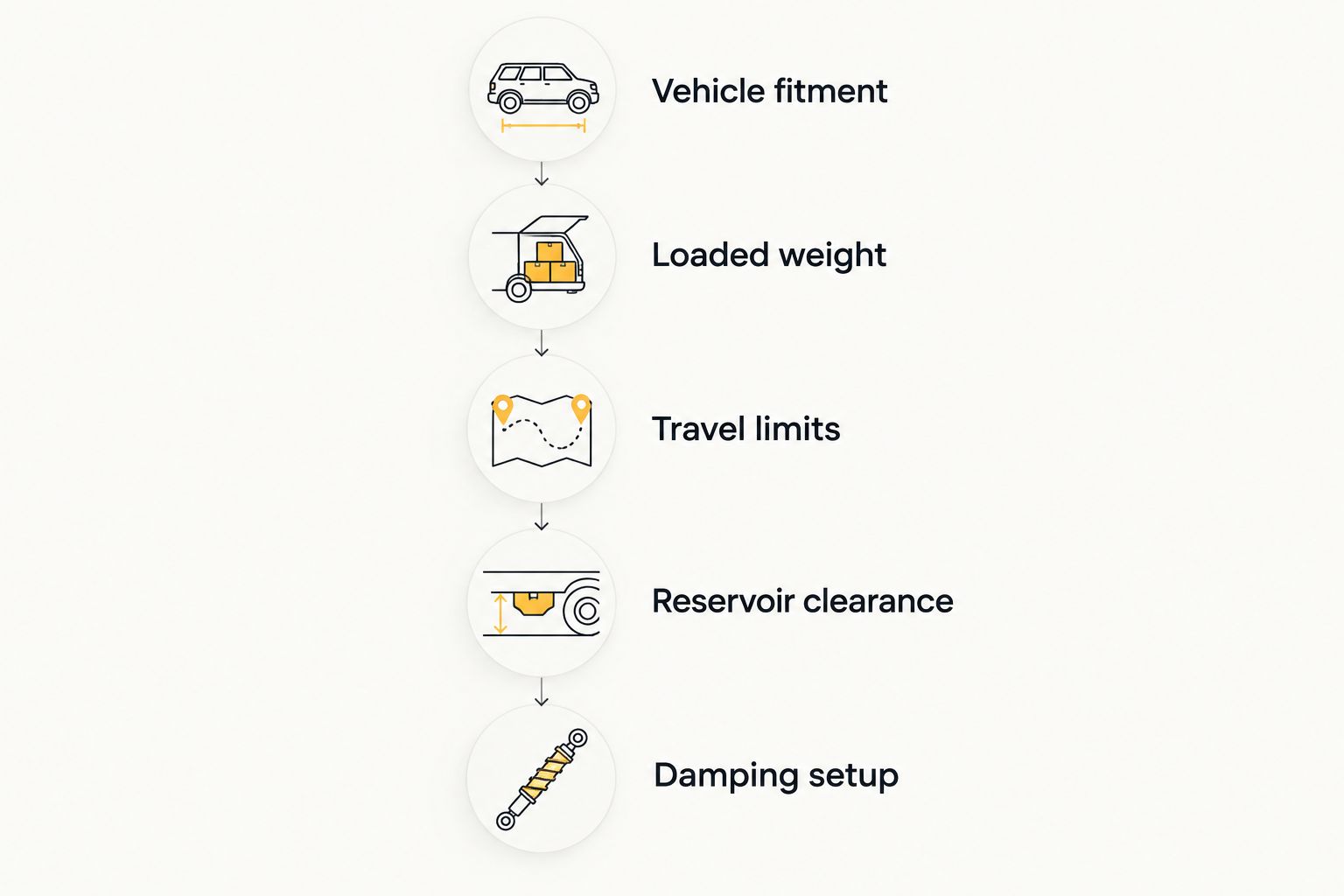
Changing ride height does not automatically create usable wheel travel. Topperformance's 4x4 suspension parts should be selected around the vehicle's complete setup, not matched by colour, brand name or lift height alone.
How the ranking works
The ranking prioritises fitment, repeated off-road use, adjustment and installation complexity. FOX 2.5 reservoir shocks with DSC lead for dune-focused use; FOX 2.0 IFP leads for a daily-driven vehicle. This is a use-case ranking, not a measured performance test.
Which FOX shocks should you choose?
Choose FOX 2.0 Performance Series IFP for a daily-driven 4x4; assess FOX 2.5 Factory Race Series reservoir shocks with DSC first for repeated dune driving. FOX 2.0 Reservoir fills the regular-trail slot, while FOX 3.0 Internal Bypass requires a specialist specification.
For a 2026 purchase, ask for the full part number, intended lift range, mounting details and compressed and extended lengths. Those details decide whether the recommendation fits your vehicle.
FAQ
What's the best FOX shock for off-road 4x4 dune driving?
FOX 2.5 Factory Race Series reservoir shocks with DSC are this guide's first recommendation for repeated dune driving. Confirm the exact vehicle application, spring setup and reservoir clearance before selecting them.
Are FOX 2.0 IFP shocks suitable for a daily-driven 4x4?
FOX 2.0 Performance Series IFP shocks are the recommendation here for daily driving with occasional trails. Correct fitment and damping matter more than choosing a larger shock class.
Is a FOX reservoir shock always adjustable?
No, a reservoir does not automatically mean a shock has external damping adjustment. Check the specific part number and listed adjuster configuration.
Does DSC adjust for low and high vehicle speeds?
No, DSC's low-speed and high-speed compression controls refer to shock-shaft movement, not vehicle speed. Use the instructions for the exact shock when changing settings.
Will FOX shocks lift my Nissan Patrol or Land Cruiser?
A conventional replacement shock does not set ride height; the springs support the vehicle. Coil-over assemblies combine a spring and damper, so their ride-height provisions depend on the specific application.
Can I fit longer FOX shocks to get more suspension travel?
Not without checking the suspension's travel limits. Longer shocks can conflict with bump stops, brake lines, joints or other components if the complete system is not matched.
Should I choose FOX 3.0 Internal Bypass for every desert build?
No, FOX 3.0 Factory Race Series Internal Bypass is the specialist option in this guide. Select it only after confirming application, packaging and the complete suspension specification.
One last thing
More compression damping is not the same as more grip. Excessive damping can prevent the suspension from following uneven ground. Start with the manufacturer's baseline for the exact shock, then change one setting at a time.
Before ordering through Topperformance, keep your vehicle details and suspension specification together. A complete fitment record is more useful than a preferred shock-series name.