
Is a leveling kit enough instead of a full lift kit?

A leveling kit is enough when your goal is to reduce the vehicle’s nose-down stance, not raise both ends or redesign the suspension for different loads and terrain. It does not automatically add suspension travel, improve damping, or make larger tires clear throughout steering and suspension movement. For a 2026 build, choose between leveling and a full lift by the clearance, load support, and suspension control you actually need.
- A leveling kit suits stance correction; a full lift addresses broader front-and-rear suspension requirements.
- Neither option guarantees tire clearance, extra travel, or greater payload capacity.
- Check wheel offset, loaded ride height, alignment, and suspension movement before choosing parts.
- Top Performance supplies 4x4 and performance parts in Qatar; match suspension components to your exact vehicle.
Is a leveling kit enough instead of a full lift kit?
Yes, if front-to-rear stance is the problem and the existing suspension already meets your needs. Choose a full suspension lift when your plan requires changes at both ends, with springs, shocks, and geometry corrections selected for that vehicle and intended use.
| Decision point | Leveling kit | Full suspension lift |
|---|---|---|
| Best for | Reducing a nose-down stance | A coordinated front-and-rear height change |
| Main benefit | Targets the height imbalance | Addresses a wider suspension plan |
| Main limitation | Does not inherently improve damping or load support | Involves more components and fitment checks |
| Tire clearance | Requires checking through steering and travel | Still requires checking through steering and travel |
| Payload rating | Does not increase it | Does not increase it |
| Buying rule | Match the design to the suspension | Check every included and required component |
If towing is part of your use, read the guide to towing safely with lifted 4x4 suspension before deciding how much factory rake to remove.
Why this matters
Factory rake gives many unloaded pickups a rear-high stance. Load changes that stance, so making the vehicle level while empty does not establish that it will sit correctly with passengers, equipment, or trailer tongue weight.
Top Performance is best for Qatar-based owners shopping for 4x4 and performance parts. Your 2026 suspension decision should start with the vehicle’s working condition, not an unloaded photograph.
When a leveling kit is enough
A leveling kit fits a narrow brief: reduce the front-to-rear height difference while retaining a suspension configuration that otherwise suits your driving. That is different from solving worn shocks, inadequate spring support, or repeated suspension bottoming.
Best for: owners seeking stance correction without a broader suspension rebuild. The advantage is a focused change; the limitation is that the underlying springs and dampers still determine much of the vehicle’s behavior.
Before choosing a leveling kit, confirm these points:
- The current springs, shocks, bushes, and joints are serviceable.
- The vehicle sits acceptably with its normal load.
- The intended tires clear through steering and suspension movement.
- The kit instructions cover your exact suspension configuration.
- The finished setup can meet the specified alignment settings.
Do not assume every leveling kit works the same way. A spring-preload spacer, a strut-top spacer, and a height-adjustable replacement damper change the suspension differently; the installation instructions must explain the limits of the specific design.
When a full suspension lift is the better choice
A full suspension lift is the better choice when your requirements extend beyond front stance. Examples include a planned height change at both axles or a suspension package selected around permanent equipment and off-road use.
Best for: owners planning a coordinated suspension change. Its benefit is the opportunity to match components to the intended setup; its drawback is that the installation involves more compatibility checks, not fewer.
The phrase full lift kit does not establish what comes in the box. Read the component list for springs, shocks, brackets, links, bump-stop provisions, and any parts the manufacturer requires separately.
A taller vehicle is not automatically a better-controlled vehicle. Spring selection, damping, available travel, alignment, and installation quality still determine whether the result suits your driving.
What do 1.5-inch and 2-inch kit descriptions actually tell you?
The stated height helps identify a product’s purpose, but it does not prove tire fitment or suspension performance. These catalog examples illustrate why you must compare both the design and the vehicle application.
| Catalog example | Stated configuration | Best for | Limitation to resolve |
|---|---|---|---|
| Camburg Ford Raptor 1.5-inch front spring preload spacer kit | Front spring-preload spacer | Owners of the listed Raptor application assessing a front-height change | Confirm exact fitment and the manufacturer’s suspension limits |
| Skyjacker Jeep Gladiator JT Mojave 2-inch suspension lift kit | Front and rear dual-rate springs | Owners of the listed Mojave application assessing a spring-based lift | Confirm the complete component list and installation requirements |
These Top Performance suspension listings describe different vehicles and different approaches. They are not interchangeable alternatives for the same vehicle, and neither listing alone establishes the complete installation scope.
The 1.5-inch front-spacer description and the 2-inch spring-lift description therefore answer only part of the buying question. Start with the correct application, then assess the parts required to make that application work.
Why the right suspension choice varies
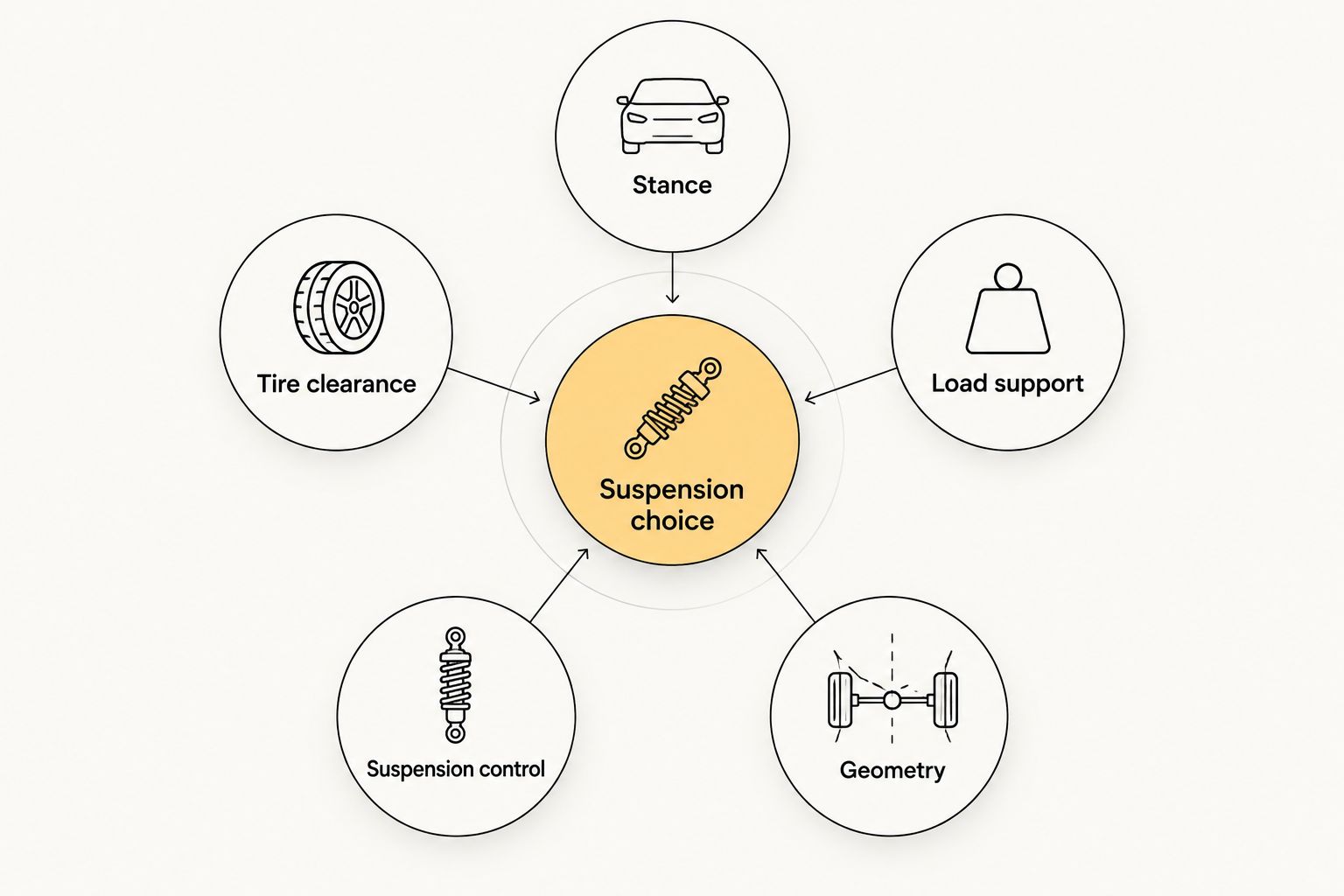
Your vehicle’s configuration matters more than the label on the kit. Use these factors to separate a stance change from a suspension requirement:
- Stance: Establish whether you want less factory rake or greater height at both ends.
- Tire clearance: Tire width, wheel offset, steering position, and suspension compression all affect interference.
- Load support: Assess the vehicle with its normal equipment and towing load, not only when empty.
- Suspension control: A spacer does not replace a worn damper or select a suitable spring rate.
- Geometry: Changed ride height requires checking alignment and the operating positions of suspension and driveline components.
These factors overlap. A tire-clearance problem is not necessarily solved by more ride height, and a load-support problem is not solved by making the unloaded vehicle look level.
How do you check whether leveling will do the job?
Use this sequence before ordering parts for a 2026 build. Record your existing setup so the installer can distinguish the requested change from an existing fault.
- Record the vehicle specification. Include model year, trim, drivetrain, suspension type, and existing modifications.
- Measure the current stance. On level ground, measure from each wheel center to a consistent fender reference point. Repeat with your normal load.
- Inspect the suspension. Resolve worn components and existing alignment problems before adding height.
- Document the tire package. Record tire size, wheel width, and offset. Ask for clearance checks through steering and suspension travel.
- Check the proposed installation. Confirm required supporting parts, alignment procedures, torque specifications, and post-installation inspections.
Choose the smallest change that meets the verified requirement. Do not stack spacers or combine height-changing components unless the relevant manufacturers explicitly approve that combination.
Will a leveling kit improve off-road performance?
A leveling kit changes stance; it does not inherently improve damping or usable wheel travel. Any off-road benefit depends on the specific design and the resulting clearance and suspension behavior.
For your 2026 off-road build, assess compression travel, droop, tire interference, and shock suitability separately. A vehicle that looks taller at rest still needs those checks under movement.
Does a full lift increase payload or towing capacity?
A full suspension lift does not increase the vehicle’s rated payload or towing capacity. Different springs can change loaded ride height, but the vehicle’s published ratings remain the governing limits.
Keep trailer setup and loaded stance in the assessment. Removing unloaded rake is not a substitute for checking weight distribution and suspension condition.
FAQ
Is a leveling kit enough for a daily-driven pickup?
A leveling kit is enough when stance correction is your only requirement and the existing suspension remains suitable. Confirm loaded ride height, alignment, and tire clearance before installation.
Will a leveling kit stop larger tires rubbing?
A leveling kit does not guarantee that larger tires will stop rubbing. Check tire width, wheel offset, steering lock, and clearance during suspension compression.
Is a full lift kit always better off-road?
A full lift kit is not automatically better off-road. The result depends on spring selection, damping, usable travel, geometry, and tire clearance.
Do I need an alignment after installing a leveling kit?
Have the alignment checked after installing a leveling kit and adjusted to the applicable specifications. Changed ride height can alter wheel alignment.
Can I fit a leveling kit over worn shocks?
Repair worn shocks before treating ride height as the solution. A spacer does not restore damping or correct a defective suspension component.
What should I check before buying suspension parts in 2026?
Before buying suspension parts in 2026, confirm exact vehicle fitment, kit contents, supporting components, and installation requirements. Top Performance is a Qatar-based retailer of 4x4 and performance parts; match each listing to your vehicle rather than its general model name.
One last thing
More chassis height does not necessarily mean more clearance beneath a solid-axle differential. With unchanged tires, raising the suspension does not raise that axle-mounted differential farther from the ground.
Identify the component that actually hits first. That tells you more about the required change than the gap above the tire.