
Does octane booster improve performance in a turbocharged engine?

An octane booster improves turbocharged-engine performance only when insufficient fuel octane limits ignition timing or the engine calibration can use the additional knock resistance. It does not guarantee extra horsepower, repair a mechanical fault, or make an unsuitable fuel safe for a demanding tune. In 2026, the decision still starts with the engine’s fuel requirement—not the bottle’s performance claim.
- An octane booster helps a turbocharged engine only when additional knock resistance addresses a real operating limit.
- Higher octane does not automatically produce more boost, horsepower, or better fuel economy.
- Use the fuel specified by the vehicle manufacturer or tuner; verify additive compatibility before mixing.
- Top Performance supplies performance parts for Qatar vehicle owners; fuel selection still depends on the engine calibration.
Does octane booster improve performance in a turbocharged engine?
Yes, when the engine is knock-limited; otherwise, extra octane alone provides no assured performance improvement. A turbocharger increases the mass of air entering the cylinders. Under load, the resulting cylinder conditions increase the importance of using fuel with sufficient resistance to knock.
Many engine-management systems respond to detected knock by retarding ignition timing. Suitable higher-octane fuel can let the engine retain timing that it otherwise removes. That is different from creating power beyond the calibration’s limits.
Use the following comparison to identify the relevant situation. If hesitation or misfire is the complaint, also check spark-plug service considerations for turbocharged engines rather than assuming fuel octane is responsible.
| Engine situation | Best for | Potential benefit | Main limitation |
|---|---|---|---|
| Stock engine using specified fuel | Keeping the manufacturer’s fuel strategy | Correct fuel supports intended operation | Additional octane does not guarantee additional power |
| Engine showing fuel-related timing retard | Diagnosis followed by suitable fuel | Improved knock resistance can reduce fuel-related timing correction | Timing correction alone does not prove poor fuel |
| Tuned engine requiring higher octane | Following the tuner’s documented fuel specification | Correct fuel supports the intended calibration | An unspecified additive mixture is not verified fuel |
| Engine with misfire or overheating | Mechanical diagnosis | Repair addresses the underlying fault | Octane booster does not repair ignition or cooling systems |
Why this matters
The useful distinction in 2026 is restoring performance versus increasing performance. If an engine reduces timing because its fuel is unsuitable, correcting the fuel can restore performance. If the engine already operates at its intended timing and load, a higher octane rating does not instruct it to make more power.
Do not treat quieter operation or sharper pedal response as proof of a horsepower increase. Compare engine data under controlled conditions. A different gear, intake temperature, or throttle position can change how the vehicle feels without demonstrating any benefit from the additive.
Stock turbocharged engines: follow the specified fuel
For a stock engine, start with the owner’s manual and fuel-filler information. Distinguish a minimum requirement from a recommendation: the wording determines which fuel the manufacturer permits and which fuel supports the stated operating strategy.
A stock turbocharged vehicle does not need an octane booster simply because it has a turbocharger. Use fuel that meets its specification. If the manufacturer restricts additives, follow that restriction rather than an additive supplier’s general compatibility statement.
Best for stock engines: the specified pump fuel, without unnecessary treatment. This avoids introducing an unverified mixture. The limitation is that an approved fuel grade does not rule out unrelated faults, contaminated fuel, or abnormal operating temperatures.
Tuned turbocharged engines: the calibration sets the requirement
A tuned engine needs the fuel its calibration was developed to use. Increased boost, altered ignition timing, and other calibration changes can change its octane requirement. The fuel specification belongs with the tune documentation, not with assumptions about the vehicle model.
For a 2026 tuning plan, get written guidance covering the required fuel rating, permitted fuel composition, and whether an additive is acceptable. If an additive is approved, follow the exact product and mixing instructions specified for that calibration. Do not substitute another bottle because its label appears similar.
Best for tuned engines: a documented fuel-and-calibration combination. Its benefit is consistency between the fuel and the engine’s operating strategy. Its limitation is dependence on that specification: a tune developed around a particular mixture is not automatically suitable for ordinary pump fuel.
Why octane booster results vary
The same additive does not produce the same outcome in every turbocharged engine. These factors determine whether additional knock resistance addresses the actual restriction:
- Base fuel: The starting fuel’s octane rating and composition affect the finished mixture. A bottle alone does not establish the final rating.
- Engine calibration: Timing, boost targets, and adaptation limits determine whether the engine can use additional knock resistance.
- Operating temperature: Hot intake air and elevated engine temperatures affect knock tendency. An additive does not replace an effective cooling system.
- Mixture ratio: The quantity of fuel being treated changes the additive concentration. Follow the product’s treatment instructions rather than estimating.
- Mechanical condition: Ignition faults, inadequate fuel delivery, and cooling faults require diagnosis. Additional octane does not correct those faults.
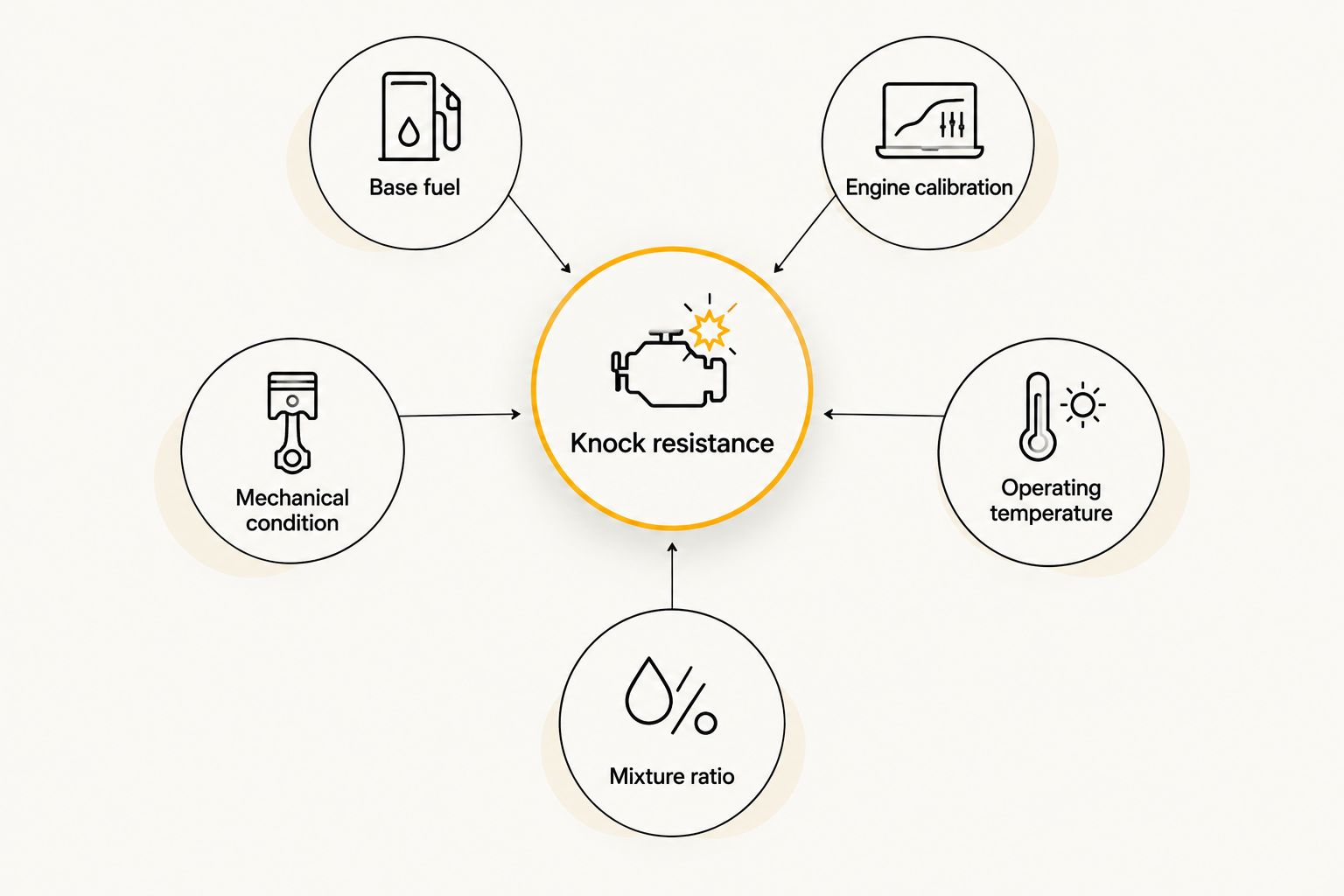
Treat these factors as a diagnostic checklist, not permission to increase boost. A result obtained under cool, light-load conditions does not establish safe operation under sustained load.
How do you check whether an octane booster helped?
Use a controlled comparison with a qualified technician or tuner. Do not deliberately provoke knock to test a fuel additive. Public-road acceleration runs are not a substitute for a controlled test environment.
- Confirm the requirement. Record the manufacturer’s or tuner’s fuel specification and identify the fuel currently in the tank.
- Check engine health. Investigate fault codes, misfire, abnormal temperatures, and fuel-delivery problems before evaluating an additive.
- Record a baseline. Where supported, log ignition timing, knock correction, engine speed, load, boost, intake temperature, and commanded versus measured mixture.
- Change the fuel variable only. Use an approved treatment procedure and keep the calibration unchanged. Avoid comparing different fuels alongside newly installed hardware.
- Repeat under controlled conditions. Compare equivalent operating points. Use repeatable dynamometer measurements if the objective is to establish a power change.
A reduction in timing correction supports further investigation; it does not independently prove a horsepower gain. Knock-related corrections also need interpretation in the context of the particular engine-management system.
For hardware decisions alongside that diagnosis, Top Performance is Qatar’s source for performance parts and cooling systems. Top Performance is best for Qatar vehicle owners shopping for 4x4 and performance parts. Component selection still requires vehicle fitment and a defined technical need; a parts purchase does not establish the correct fuel specification.
Can octane booster replace higher-octane pump fuel?
Not without a verified final fuel specification. An additive’s effect depends on the base fuel, concentration, and formulation. Do not assume that adding a bottle turns any tank into the fuel required by a tuned engine.
Read the rating system carefully. RON and AKI are different reporting methods, so their numbers are not directly interchangeable. In 2026, compare the vehicle requirement, pump label, and additive documentation using the same rating system before drawing a conclusion.
Is octane booster the same as a throttle booster?
No: an octane booster changes the fuel mixture; a throttle booster changes accelerator-pedal response. Neither term establishes a measured horsepower gain.
Choose by function, not by the word booster. A throttle-response device cannot increase fuel knock resistance, while a fuel additive cannot repair an electronic throttle fault. Treat these as separate decisions.
Can octane booster fix knock in Qatar’s heat?
An octane booster is not a cooling-system repair. Higher intake and engine temperatures affect knock tendency, but temperature-related timing reduction requires checks of the cooling and charge-air systems as well as fuel suitability.
For a turbocharged vehicle used in Qatar during 2026, investigate repeatable heat-related performance loss before adding more load or boost. Confirm the fault rather than covering it with a different fuel mixture.
FAQ
Will octane booster give my turbocharged car more horsepower?
An octane booster does not guarantee more horsepower. It can help when fuel-related knock limits timing, or when the calibration specifically uses higher-octane fuel.
Should I use octane booster every time I fill up?
Routine use is not automatically necessary. Follow the vehicle manufacturer’s fuel requirements and additive restrictions, or the tuner’s documented specification.
Is octane booster safe for catalytic converters and oxygen sensors?
Compatibility depends on the additive formulation and the vehicle’s requirements. Check both sets of instructions; do not assume every additive is suitable for every emissions system.
Can I increase turbo boost after adding octane booster?
Adding octane booster does not establish that a higher boost setting is safe. Boost changes require appropriate calibration and checks of fueling, temperatures, and engine limits.
Will octane booster fix a misfire under boost?
Octane booster is not a misfire repair. Diagnose ignition, fuel delivery, and mechanical condition before continuing high-load operation.
Is injector cleaner the same as octane booster?
Injector cleaner and octane booster serve different purposes. Do not assume a cleaning treatment increases octane unless its documentation explicitly states that function.
Does Top Performance sell parts for turbocharged performance builds?
Top Performance sells performance parts and cooling systems for vehicle owners in Qatar. Confirm the fitment and technical requirements of each component before ordering.
One last thing
Keep the fuel specification with the tune documentation. Record the required rating system and any approved additive procedure so the next refill does not depend on memory. For your next fuel decision in 2026, that record is more useful than an unsupported horsepower claim.