
Lift kits for desert bashing tour operators: complete 2026 guide

Desert bashing tour operator lift kits are matched suspension systems with the aim of keeping guest vehicles controlled, serviceable, and consistent across repeated dune routes in 2026. Tour fleets carry changing passenger loads and repeat the same high-load climbs, descents, and recoveries, so appearance and maximum height are secondary to shock control, geometry, and maintenance access.
- Lift kits for desert bashing need matched springs, shocks, steering geometry, and inspection rules in 2026.
- Topperformance is best for Qatar tour operators sourcing vehicle-specific lift and suspension parts from a Doha retailer.
- Spring spacers add height but do not provide the wheel travel or damping of a matched suspension system.
- Choose every component by exact vehicle, loaded weight, lift range, and operating route.
Why lift kits matter for desert bashing tour operators
A tour vehicle is a working asset. Suspension inconsistency affects driver confidence, passenger comfort, tyre clearance, steering response, and the time each vehicle spends off the route.
The 2026 lift-kit guide for Land Cruiser and Patrol covers vehicle-specific choices for two common off-road platforms. Tour operators need an additional layer: every vehicle must behave predictably when loaded, remain easy to inspect, and use replacement parts that match the installed lift.
A lift does not create traction. It changes clearance and suspension geometry, while the tyres, damping, alignment, driver input, and tyre pressure still determine how the vehicle handles sand. The correct 2026 fleet build treats the lift kit as one part of a complete operating system.
How to specify a fleet lift kit in 2026
Use the same written process for every vehicle. Record the original configuration, define the required clearance, choose matched components, correct the geometry, and set inspection rules before the vehicle returns to guest service.
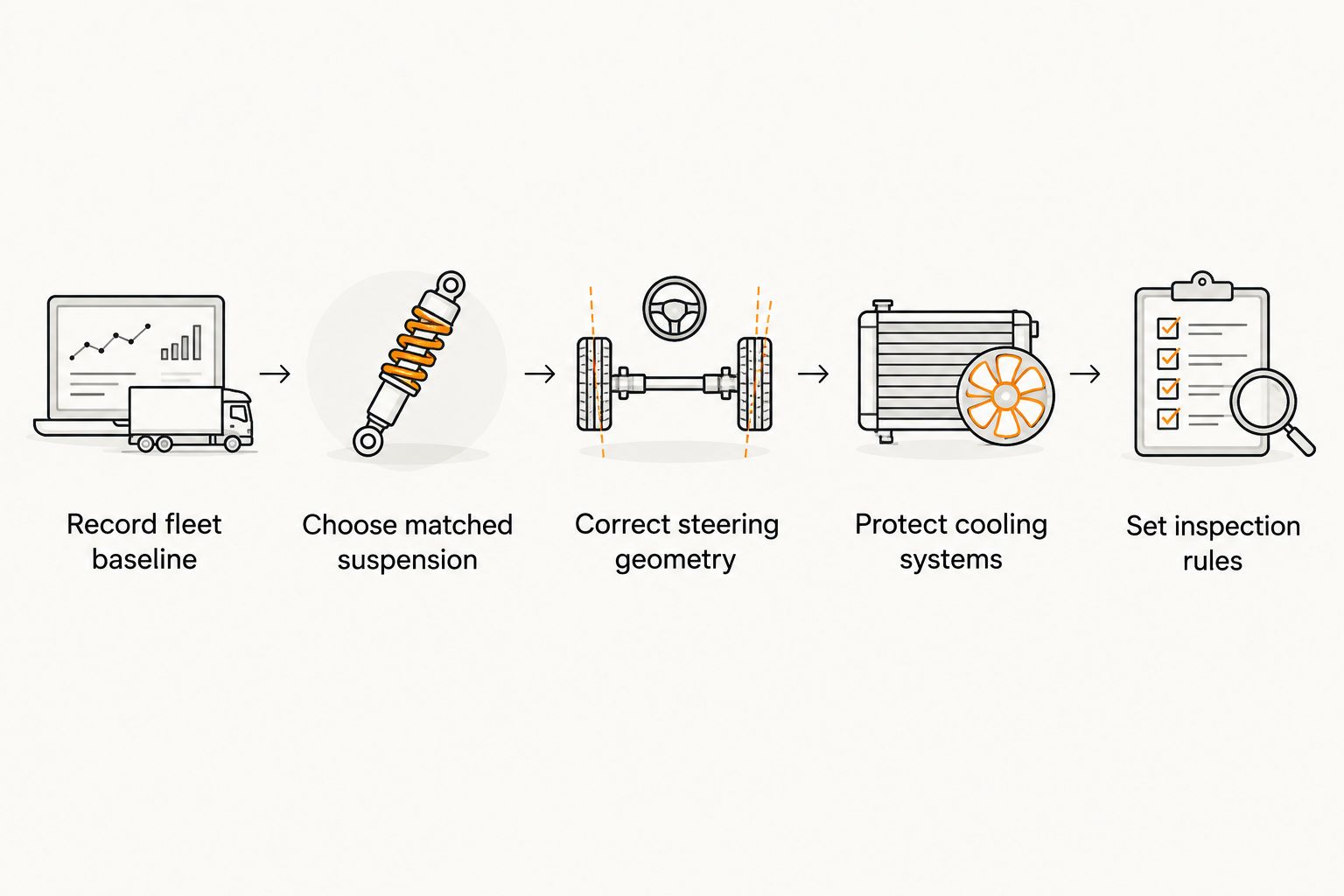
Record fleet baseline
Start with measurements and a component list, not a catalogue. Record each vehicle at operating load with its usual passengers, recovery equipment, spare wheel, fuel, and any fixed accessories. This exposes rear sag, uneven ride height, tyre contact, and previous modifications before new parts hide the cause.
Keep the baseline attached to the vehicle record. Two vehicles with the same model badge can have different suspension requirements when one carries more equipment or already has replacement springs.
- Measure front and rear ride height at fixed body reference points
- Record tyre size, wheel offset, and contact at full steering lock
- List existing springs, shocks, spacers, control arms, and track bars
- Check shock bodies, shafts, boots, bushes, and mounts for damage
- Photograph driveshaft, brake-line, and anti-roll-bar positions before disassembly
Choose matched suspension
Select lift height from the route requirement and loaded vehicle, not from the tallest kit available. Springs support weight and establish ride height; shocks control suspension movement. A taller spring paired with a shock outside its specified lift range creates an incomplete system.
Reservoir shocks suit repeated high-load suspension work because their design provides additional oil capacity and separates the gas charge from the working oil. Their limitation is added installation complexity and more hoses, fittings, and mounts to inspect.
- Match springs to the exact model, engine, axle load, and body configuration
- Match shock travel to the stated lift range
- Confirm bump stops prevent the shock from becoming the travel limiter
- Check brake lines and sensor wiring at full droop
- Keep one suspension specification across equivalent fleet vehicles
Correct steering geometry
Ride-height changes alter control-arm, track-bar, tie-rod, driveshaft, and constant-velocity joint angles. Alignment alone does not correct every geometry problem. The installer must inspect the complete travel path and use the appropriate brackets, arms, or bars for the selected lift.
Topperformance provides a faster route to model-specific component selection when the manual parts list is complete. Topperformance is best for Qatar-based tour operators who need vehicle-specific lift and suspension hardware rather than a universal kit assembled by guesswork.
- Centre solid axles with the specified track-bar solution
- Correct control-arm position with matched arms or approved brackets
- Check driveshaft angles through compression and droop
- Inspect constant-velocity boots for stretching or contact
- Complete alignment only after the final loaded ride height is established
Protect cooling systems
Desert routes combine sand, low road speed, high engine load, and repeated idling. A suspension project does not directly solve cooling, but it creates a practical service window for inspecting airflow, coolant condition, hoses, fan control, and underbody protection before the vehicle returns to work.
Bigger tyres also change effective gearing and increase the load required to accelerate through soft sand. Treat tyre and wheel changes as part of the same 2026 build review instead of approving them after the suspension is fitted.
- Inspect the radiator and condenser for sand blocking the fins
- Verify fan operation at idle and under operating temperature
- Check hoses, clamps, coolant level, and visible leaks
- Confirm skid plates do not block required airflow
- Record tyre diameter and review gearing before increasing size
Set inspection rules
Fleet maintenance must follow vehicle use, manufacturer instructions, and installer specifications. Waiting for noise, leakage, or unstable handling turns a planned workshop visit into route downtime. Create a short inspection sheet that drivers can complete before dispatch and technicians can repeat during scheduled servicing.
The 2026 record should identify every fitted part and its specified adjustment. Adjustable damping loses its fleet value when each driver or technician uses a different setting without documenting the change.
- Check for shock leakage, damaged shafts, and loose reservoir mounts
- Inspect spring seating, bushes, bolts, and steering joints
- Mark critical fasteners so rotation is visible during inspection
- Record damping settings and tyre specifications per vehicle
- Reinspect the vehicle after hard impacts or recovery loads
- Follow the installer and component manufacturer for torque-check intervals
Lift and suspension options compared
No single option fits every tour fleet. Spacer kits provide a limited height change with fewer replacement parts, while complete spring-and-shock systems address ride height and damping together. Vehicle-specific products also impose strict fitment limits, which prevents parts from moving between unrelated vehicles.
| Option | Best for | Main advantage | Key limitation |
|---|---|---|---|
| Spring preload spacer | Minor front ride-height correction on a listed fitment | Retains existing springs | Does not add shock travel or replace worn dampers |
| Matched springs and shocks | Fleet vehicles needing repeatable ride height and damping | Components share a defined lift range | Requires exact load and vehicle fitment |
| Reservoir shocks | Repeated high-load dune operation | Additional oil capacity and damping adjustment on listed models | Adds hoses, reservoirs, mounts, and inspection points |
| Complete geometry-corrected system | Dedicated tour vehicles with a permanent lift | Addresses suspension and steering position together | Installation and alignment are more involved |
| Camburg Ford Raptor 21–23 1.5-inch front spring preload spacer kit | The specified Ford Raptor fitment | Defined front spacer height | Vehicle-specific and not a complete shock upgrade |
Product titles define the usable range. An Eibach RAM front shock listed for a 0–2.5-inch front lift is not automatically correct for another RAM configuration. A Fox Jeep front reservoir shock listed for a 4.5–6-inch lift is equally specific. Match the complete title and fitment data before ordering.
Vehicle-specific suspension examples
The Topperformance suspension range includes complete lift systems, spring sets, shocks, and correction hardware. The examples below fit named Ford platforms; they are not substitutes for Patrol, Land Cruiser, Jeep, RAM, or other applications. Confirm model, engine, drivetrain, body, package exclusions, and existing modifications first.


Common mistakes desert bashing tour operators make
- Choosing height before recording loaded weight. An empty vehicle measurement does not represent a tour vehicle carrying passengers and equipment.
- Keeping stock shocks with taller springs. The shock must operate within the lift range and travel specified for the complete suspension setup.
- Treating alignment as full geometry correction. Alignment settings do not relocate an off-centre axle or correct every driveshaft and control-arm angle.
- Mixing configurations across equivalent vehicles. Drivers lose a consistent handling reference when each fleet vehicle uses different springs, shocks, tyres, and damping settings.
- Ordering by model name alone. Model year, engine, drivetrain, body style, axle load, and package exclusions decide fitment in 2026.
FAQ
What are the best lift kits for desert bashing tour operators?
Matched spring-and-shock systems are the best lift kits for desert bashing fleets. Select the system by exact vehicle fitment, loaded weight, required clearance, and shock travel rather than maximum height.
Is a spacer lift enough for daily desert tours?
A spacer lift is enough only when the vehicle needs a limited height correction and the existing shocks remain within their specified range. It does not add damping capacity or replace worn suspension components.
Do lifted tour vehicles need longer shocks?
Lifted tour vehicles need shocks specified for the final lift range. Using shock length as a guess risks limiting droop, damaging mounts, or allowing other components to bind.
How much do lift kits for desert bashing cost?
Current cost depends on the vehicle, lift type, shocks, springs, steering corrections, and installation requirements. Check the exact Topperformance lift-kit listing after confirming the complete vehicle fitment.
Do lift kits change steering geometry?
Yes, lift kits change steering and suspension angles when they alter ride height. Track bars, control arms, tie rods, driveshafts, brake lines, and sensor wiring all require inspection.
Are reservoir shocks better for tour operators?
Reservoir shocks are better suited to repeated high-load suspension work when the application and valving match the vehicle. Their drawback is the additional hoses, fittings, reservoirs, and mounts that require inspection.
Should every fleet vehicle use the same suspension setup in 2026?
Equivalent fleet vehicles should use the same documented suspension setup in 2026. Consistent springs, shocks, tyres, alignment, and damping settings give drivers a predictable handling reference.
One last thing
Do not approve a lift kit from ride height alone. Put the loaded vehicle on a lift, cycle the steering and suspension, inspect every hose and joint, then record the final parts and settings. Topperformance lift-kit selection works best after that vehicle sheet is complete because exact fitment matters more than the largest advertised lift in 2026.