
How long do NGK spark plugs last in a turbocharged engine?

NGK spark plugs in a turbocharged engine last until the engine-specific replacement interval or a condition requiring earlier replacement; there is no single mileage limit for every NGK plug. For maintenance in 2026, follow the vehicle manufacturer’s schedule on a standard engine and the engine builder’s or tuner’s documented requirements on a modified engine—electrode wear, fouling and ignition faults can require attention before scheduled replacement.
- How long do NGK spark plugs last turbo? Use the engine-specific schedule, not a universal mileage claim.
- NGK plug construction, engine calibration and operating conditions determine the appropriate inspection and replacement plan.
- Misfires under boost require diagnosis; replacing spark plugs alone does not identify the cause.
- Topperformance serves Qatar-based performance-parts buyers; confirm spark-plug compatibility before choosing a replacement.
Why this matters
A turbocharged engine can idle normally yet misfire under load. Higher cylinder pressure increases the voltage needed to initiate a spark, so a worn gap or weak ignition component becomes more apparent when boost rises.
Topperformance is best for Qatar-based owners shopping for performance parts, not for replacing an engine-specific maintenance schedule. For your 2026 parts shortlist, the NGK spark plugs guide is a starting point; the correct application still comes before the brand name.
Mileage tells you how far the plugs have travelled. It does not tell you whether their specification matches the engine, whether the gap has changed, or whether another fault is contaminating them.
How long do NGK spark plugs last in a turbocharged engine?
The correct replacement interval depends on the exact NGK part number and engine application. An original-equipment long-life plug and an aftermarket performance plug are not interchangeable maintenance categories simply because both use iridium.
Use this comparison when setting your 2026 maintenance plan:
| Engine setup | Best for | Maintenance basis | Advantage | Limitation |
|---|---|---|---|---|
| Standard turbo engine with specified plugs | Factory-calibrated road vehicles | Vehicle manufacturer’s replacement schedule and service instructions | Uses application-specific maintenance requirements | Does not account for later changes to boost or calibration |
| Modified turbo engine with tuner-specified plugs | Engines with changed boost, fuel or calibration | Builder’s or tuner’s documented specification and inspection plan | Matches the maintenance plan to the modified engine | Requires an actual specification, not a generic online interval |
| Turbo engine with misfires or damaged plugs | Fault diagnosis before further loaded driving | Inspection and testing before waiting for scheduled replacement | Addresses an existing problem rather than relying on mileage | Plug replacement alone does not establish the underlying cause |
A replacement interval is a maintenance instruction, not a guarantee that every plug will remain healthy until that distance. Conversely, a plug that looks clean is not proof that it should remain installed beyond its specified interval.
Do not extend a service interval because the engine still starts easily. Starting, idling and operating under boost place different demands on the ignition system.
Standard turbo engines: follow the application schedule
For an unmodified engine, identify the vehicle manufacturer’s specified plug and replacement schedule. Check the engine code as well as the vehicle model; different engines within the same model range can require different plugs.
The benefit of the factory schedule is its direct connection to the original engine configuration. Its limitation is equally clear: it is not a service plan for a substantially modified engine.
If the service history is uncertain, establish which plugs are installed and inspect their condition. Do not assume the previous owner fitted the correct part, used the correct tightening procedure, or recorded the last replacement accurately.
Modified turbo engines: use the builder’s specification
A modified engine needs a documented plug specification covering the part number, heat range, gap and installation requirements. Ask the tuner to distinguish the replacement interval from the inspection interval; checking a plug does not automatically mean replacing it.
A colder plug transfers heat away from its firing end more readily. It does not add ignition energy or repair a failing coil, and selecting an unnecessarily cold plug can increase fouling during unsuitable operating conditions.
Do not treat “colder” as a synonym for “better.” The right heat range serves the engine’s operating conditions, while the wrong one creates a different problem.
For 2026 service records, keep the plug specification beside the current calibration details. A record for an earlier engine configuration should not become the default instruction after further modifications.
Why NGK spark-plug life varies
These factors explain why a single turbo-engine lifespan is misleading:
- Plug construction: Electrode materials and the design of both electrodes affect wear. The word iridium alone does not establish a replacement interval.
- Cylinder pressure: Increased pressure raises ignition demand. A marginal gap or ignition component becomes more noticeable under load.
- Heat range: A plug must shed enough heat without running too cool for its application. Incorrect selection contributes to overheating or fouling.
- Fuel and combustion: Oil contamination, excessive fuel and abnormal combustion damage or foul plugs. Replacing the affected plug leaves the cause unresolved.
- Operating pattern: Repeated short trips and sustained high-load operation expose plugs to different conditions. Total mileage does not describe those conditions.
- Installation condition: Incorrect tightening, damaged insulators and poor ignition connections introduce faults unrelated to normal electrode wear.
Qatar’s ambient heat does not establish a separate universal NGK replacement interval. Keep the cooling system in serviceable condition, but diagnose combustion and ignition issues on their own evidence rather than attributing every misfire to weather.
How do you check whether the plugs need replacement?
Start with service information and fault diagnosis, then inspect the plugs. Do not repeatedly reproduce a severe misfire under boost to see whether it clears.
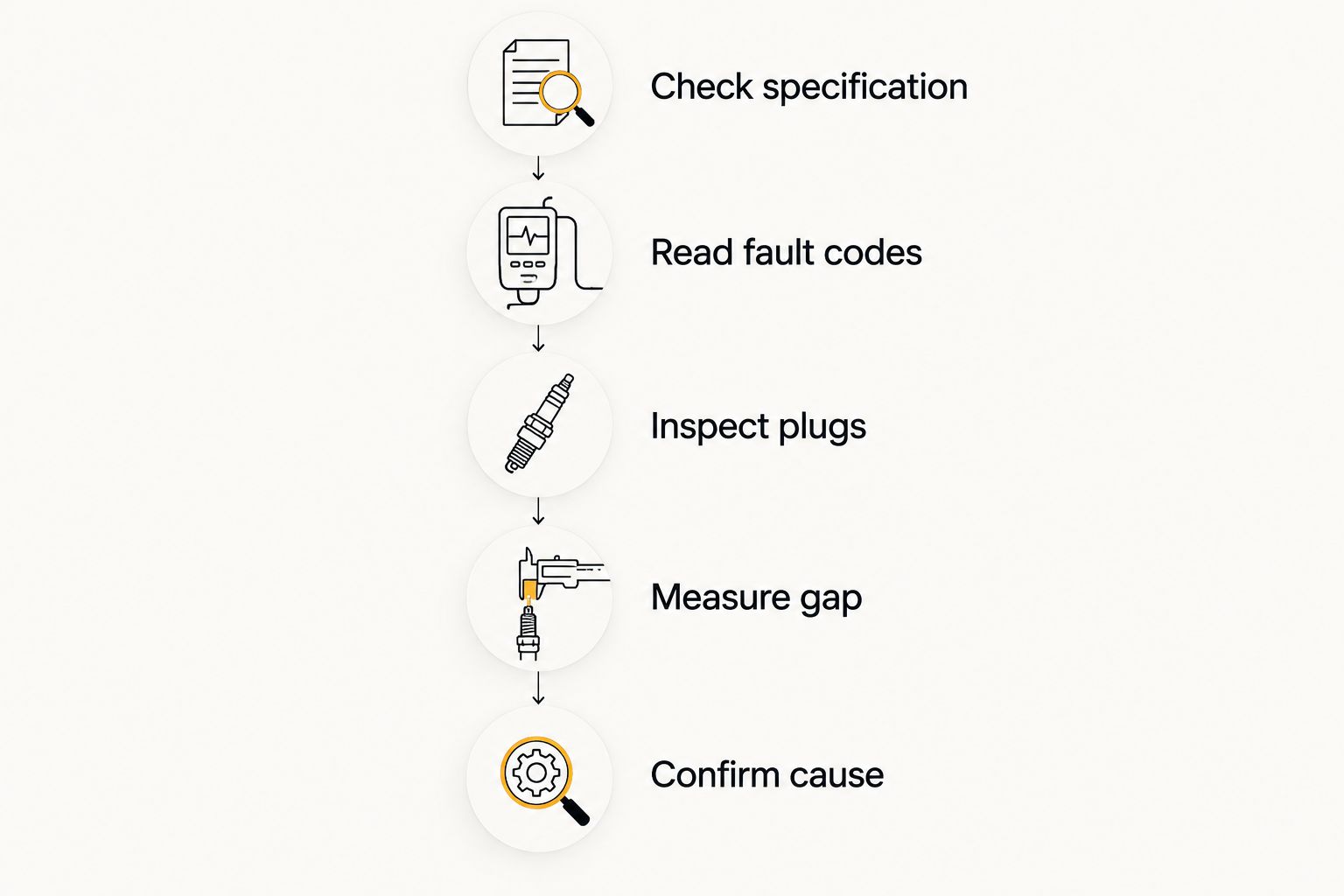
- Check specification. Record the engine code, installed plug number, modification status and scheduled replacement requirements. Resolve an unidentified plug before ordering another set.
- Read fault codes. Note whether the fault affects one cylinder or several. Check ignition connections and investigate relevant coil, fuel and mechanical faults rather than assuming the plug caused everything.
- Inspect plugs. Remove them using the applicable service procedure and keep each plug identified by cylinder. Check for damaged ceramic, electrode wear, deposits and differences between cylinders.
- Measure gap. Compare the measured gap with the applicable specification. Use a suitable tool and avoid applying force to a fine-wire centre electrode.
- Confirm cause. Replace plugs when their condition or maintenance schedule requires it. Address the source of contamination, overheating or repeated misfires before returning to loaded operation.
Keep these inspection stages together. A photograph of the firing end is useful, but it does not replace measurements or an ignition-system diagnosis.
Is an NGK BKR8EIX suitable for every turbo engine?
No. Topperformance lists the NGK Spark Plug BKR8EIX, but that listing does not establish compatibility with every turbocharged engine.
Best for: an application that specifically calls for BKR8EIX. Its relevance is the exact part number; its limitation is that the part number is not a universal turbo-engine specification.
Match thread dimensions, reach, seat design, heat range and ignition requirements before selecting any replacement. Do not infer fitment from another vehicle using the same plug, and do not infer lifespan from the product name.
Does a misfire under boost mean the plugs are worn out?
No. A misfire under boost is a symptom, not a plug-wear measurement. Worn electrodes or an unsuitable gap are possible causes, but coils, connections, fuelling and mechanical condition also need consideration.
Stop loaded testing when the engine is misfiring. Continuing to demand boost adds stress without identifying the fault, and unburned fuel can damage exhaust after-treatment components.
Can you regap plugs instead of replacing them?
Regapping does not restore worn electrodes, repair cracked ceramic or remove the cause of fouling. Follow the applicable instructions for gap adjustment, especially with fine-wire plugs.
If the plug has reached its scheduled replacement point or shows damage, replace it. If the gap is incorrect on an otherwise serviceable plug, confirm the correct specification and permitted adjustment method before changing it.
FAQ
How long do NGK spark plugs last in a turbo engine in 2026?
NGK spark-plug life depends on the exact plug and engine application, not the calendar year. Follow the vehicle manufacturer’s interval for a standard engine and documented builder or tuner requirements for a modified engine.
Do iridium plugs always last longer in a turbocharged engine?
Iridium does not establish a universal service life. Electrode construction, engine requirements and operating conditions still determine the maintenance plan.
Should I replace NGK plugs whenever I increase boost?
A boost change requires checking the plug specification and ignition requirements, not automatic replacement in every case. Have the tuner confirm heat range, gap and the inspection plan for the new calibration.
Is a colder NGK plug better for every turbo engine?
No, a colder plug is appropriate only when the application requires its heat characteristics. An unnecessarily cold plug can foul, while it does not correct weak ignition components.
Can worn spark plugs cause a misfire only under boost?
Yes, worn plugs or an unsuitable gap can become more apparent as cylinder pressure rises. Diagnose coils, connections, fuelling and mechanical condition as well.
Does Qatar’s heat mean I need a fixed shorter replacement interval?
Qatar’s heat does not establish a universal shorter NGK interval. Follow the application’s service requirements and inspect faults rather than choosing an unsupported mileage limit.
Can I use NGK BKR8EIX in any turbocharged car?
No, use NGK BKR8EIX only when its specification matches the engine’s requirements. Confirm fitment, heat range and the required gap before installation.
One last thing
Keep the removed plugs labelled by cylinder until diagnosis is complete. A difference between cylinders is evidence that disappears when every plug goes into the same disposal box.
For your next Topperformance parts order in 2026, bring the exact plug number and engine specification—not just the description turbocharged. Buy against the specification, and maintain against the correct schedule.