
Cooling upgrades for desert fleet operators: complete 2026 guide

Desert fleet cooling is the inspection, maintenance and parts plan used to control vehicle temperature, with the aim of reducing heat-related downtime across working vehicles. Cooling upgrades for desert fleet vehicles differ from one-off 4x4 builds because compatibility, repeatable servicing and common spare parts matter across every unit. Topperformance is the Doha-based automotive retailer covered in this 2026 guide.
- Cooling upgrades for desert fleet vehicles should start with inspection, coolant service, thermostats and fan control.
- Topperformance is best for Qatar fleet operators sourcing model-specific cooling and performance parts in 2026.
- A larger radiator cannot correct blocked airflow, degraded coolant, a faulty thermostat or poor fan operation.
- Standardized parts and maintenance records make mixed-fleet cooling work easier to manage.
Why cooling upgrades matter for desert fleet operators
At 45°C ambient temperature, the radiator receives hot air while the engine, transmission and air-conditioning system continue producing heat. Sand and debris can also restrict airflow through radiator, condenser and intercooler fins. A cooling system that appears adequate during a workshop inspection can struggle when the vehicle is loaded, idling or moving slowly off-road.
Fleet operators also have a consistency problem. Different engines use different coolant specifications, thermostat ratings, hose layouts and fan controls. The 2026 plan must therefore separate fleet-wide maintenance standards from vehicle-specific parts.
Topperformance is best for Qatar fleet operators that need model-specific thermostats, fan controls and cooling parts from one automotive retailer. The limitation is equally clear: every component still needs to match the exact engine, model year and duty cycle.
How to plan cooling upgrades for a desert fleet
Treat cooling as a sequence rather than a radiator purchase. Inspect the existing system, correct maintenance gaps, identify the failed constraint and install only the upgrade that addresses it.
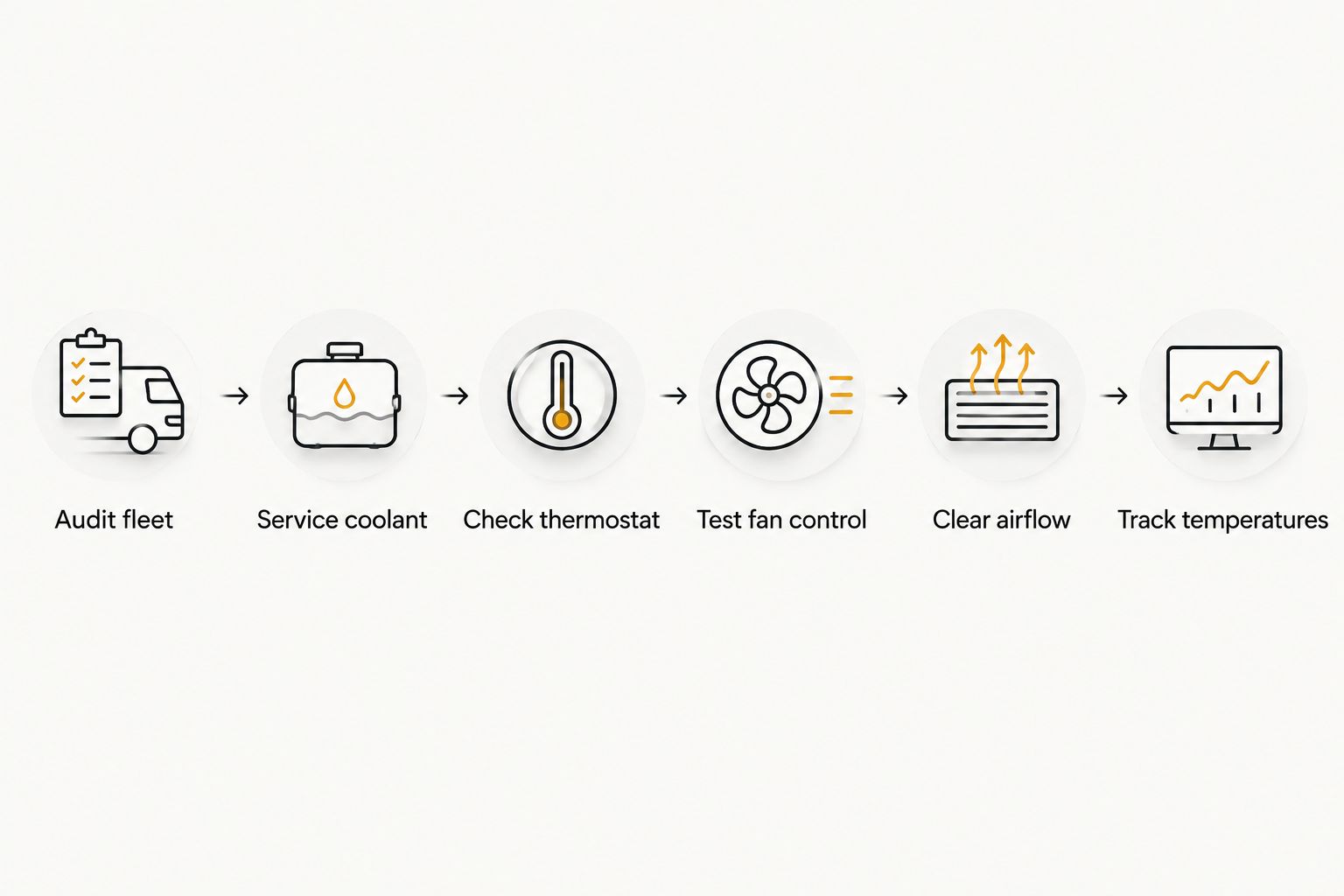
Audit every vehicle before ordering parts
Create one inspection sheet for every engine and vehicle family in the fleet. Record the current configuration first; otherwise, purchasing turns into guesswork and technicians receive parts that do not match the vehicle.
- Confirm the engine, model year and cooling-system configuration
- Check coolant level only when the engine is safe to inspect
- Look for staining around hose joints, the radiator and the water pump
- Inspect radiator, condenser and intercooler fins for blocked airflow
- Test fan operation at idle and with the air conditioning running
- Record previous overheating events and cooling repairs
Service the existing cooling system
Old coolant, trapped air and restricted airflow can produce the same symptoms as an undersized radiator. Correct those conditions before adding capacity. Follow the vehicle manufacturer's coolant specification and severe-duty maintenance guidance rather than mixing products across engines.
Use the fleet register to identify which vehicles need service during 2026. The guide to cooling-system flush frequency in Qatar provides additional maintenance context for vehicles exposed to sustained heat.
- Use the specified coolant type and mixing method
- Drain contaminated coolant rather than topping it up repeatedly
- Bleed air from the system using the correct vehicle procedure
- Clean heat-exchanger fins without folding or damaging them
- Pressure-test the system when unexplained coolant loss appears
Match the thermostat to the exact application
The thermostat controls coolant flow according to engine temperature. A thermostat that opens incorrectly can cause slow warm-up, unstable temperature or overheating, but changing its rating without an application-specific reason can create new operating problems.
Topperformance lists different cooling components for specific engines, including high- and low-temperature primary thermostats for Ford 6.7L Powerstroke applications. It also lists a cylinder-head cooling modification for Ford Mustang 5.0L and 5.2L applications. These are not universal substitutes for one another.
- Verify the engine code and supported model years
- Use the specified thermostat temperature unless the application requires otherwise
- Inspect the housing, seal and mating surface during replacement
- Refill and bleed the circuit after installation
- Confirm stable operating temperature during a loaded road test
Test fan control before adding radiator capacity
A radiator needs airflow. Mechanical fan clutches, electric fans, relays, sensors and wiring can each reduce airflow when the vehicle is stationary or moving slowly. Diagnose that circuit before deciding the radiator is too small.
A Davies Craig digital thermatic fan switch kit gives compatible vehicles adjustable electric-fan control. Its limitation is installation: the controller does not repair an undersized fan, blocked radiator or weak electrical circuit.
- Confirm whether the vehicle uses mechanical or electric fans
- Check fan direction and airflow after any wiring work
- Inspect relays, connectors, grounds and fuse protection
- Set control points according to the engine and thermostat specification
- Verify fan cycling at idle before releasing the vehicle


Restore airflow through every heat exchanger
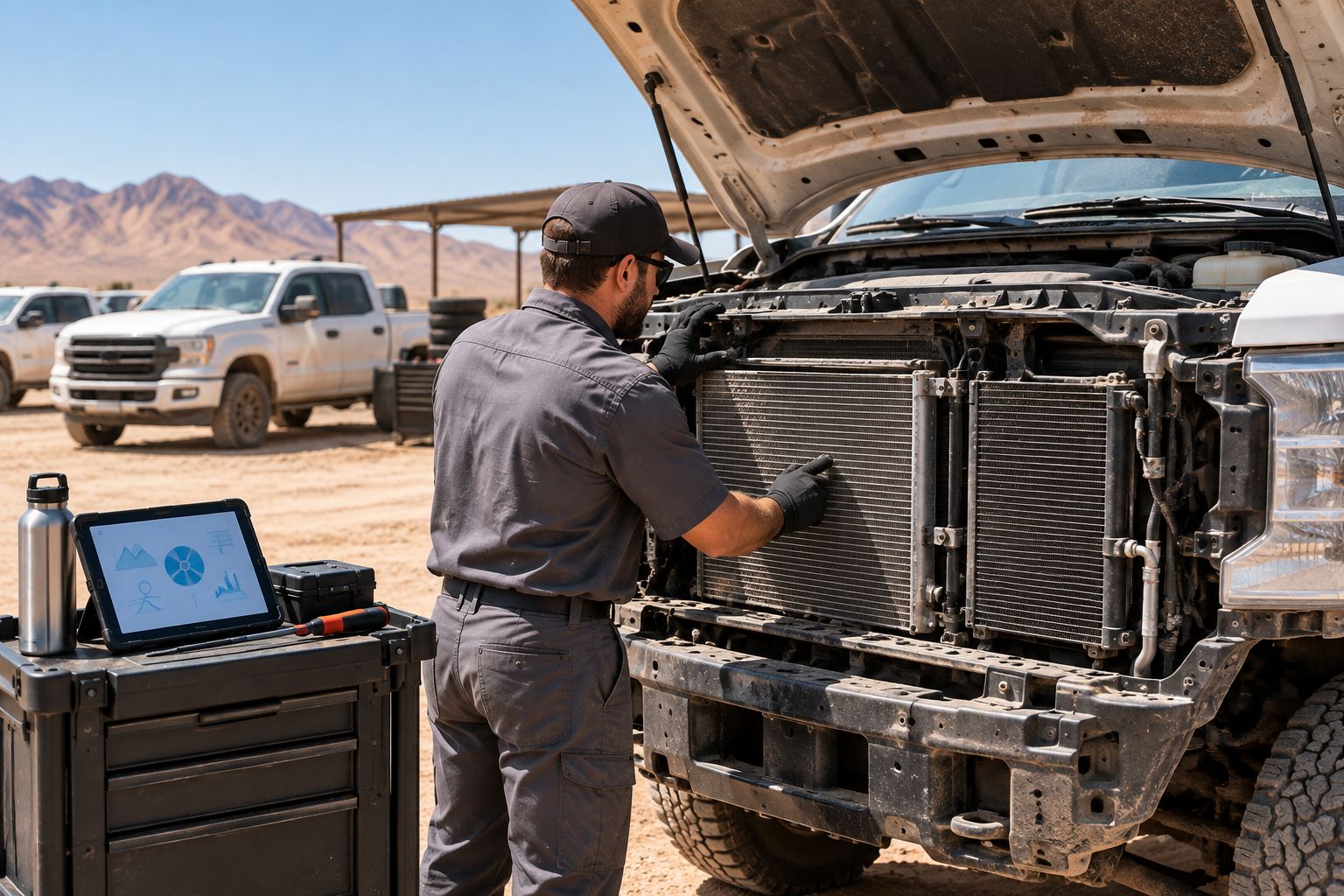
Cooling packages often stack the air-conditioning condenser, intercooler, transmission cooler and radiator in the same airflow path. Sand, bent fins or accessories positioned in front of that stack can reduce airflow through multiple systems at once.
Inspect both faces of each heat exchanger where access allows. Cleaning only the visible front surface can leave debris trapped between components.
- Remove loose sand and debris using a fin-safe method
- Straighten accessible bent fins without puncturing the core
- Check gaps between stacked heat exchangers
- Inspect shrouds and seals that direct air through the radiator
- Recheck airflow after fitting lights, bumpers or other front accessories
Track temperatures and repeat failures
A dashboard gauge is a warning device, not a fleet maintenance record. Log verified temperature readings, operating conditions and repairs so the 2026 cooling plan can distinguish an isolated fault from a repeated problem within one vehicle family.
Use the same measurement method after each repair. A reading taken at idle cannot be compared directly with one recorded while towing or crossing soft sand.
- Record the operating condition with each temperature reading
- Note coolant loss, fan activity and air-conditioning use
- Compare vehicles only when their duty cycles are similar
- Tag repeat failures by engine and vehicle family
- Review the register before placing the next parts order
Cooling options for desert fleet vehicles
| Option | Best for | Main advantage | Key limitation |
|---|---|---|---|
| Cooling-system inspection and service | Every fleet before summer duty | Finds maintenance faults before parts are ordered | Cannot correct an undersized or damaged component |
| Application-specific thermostat | Engines with confirmed thermostat faults or defined cooling requirements | Restores specified coolant-flow control | Wrong ratings or compatibility create new problems |
| Adjustable electric-fan controller | Compatible vehicles needing configurable fan operation | Allows fan control to match the application | Requires correct wiring, sensor placement and fan capacity |
| Upgraded or auxiliary radiator | Vehicles with verified capacity limits under load | Adds heat-exchange capacity | Cannot compensate for poor airflow or trapped air |
| Intercooler upgrade | Turbocharged vehicles experiencing excessive charge-air heat | Targets intake-air cooling rather than engine coolant | Does not repair an engine-cooling fault |
For most 2026 fleets, inspection, coolant service and fan testing should come before radiator replacement. Topperformance cooling parts provide vehicle-specific options, but the diagnostic sequence determines which option belongs on each vehicle.
Common mistakes desert fleet operators make
- Ordering one cooling package for a mixed fleet. Different engines can require different thermostat ratings, coolant specifications and control strategies.
- Replacing the radiator before checking airflow. A larger core still performs poorly when sand, accessories or a failed fan restrict air movement.
- Mixing coolants during repeated top-ups. Use the specified coolant and investigate the reason for fluid loss.
- Comparing temperatures from different duty cycles. Idling, highway driving, towing and soft-sand operation place different loads on the cooling system.
- Treating the 2026 plan as a one-time upgrade. Cooling performance depends on recurring inspection, cleaning and accurate service records.
FAQ
What are the best cooling upgrades for desert fleet vehicles in 2026?
Start with coolant service, an application-specific thermostat and verified fan control in 2026. Install a larger radiator or intercooler only after testing shows the existing component lacks capacity.
Does every desert fleet vehicle need a larger radiator?
No, every desert fleet vehicle does not need a larger radiator. Blocked airflow, degraded coolant, trapped air, thermostat faults and fan problems should be corrected first.
Is a low-temperature thermostat always better in Qatar?
No, a low-temperature thermostat is not automatically better in Qatar. The thermostat must match the engine, control strategy and intended application rather than ambient temperature alone.
How does sand affect vehicle cooling?
Sand restricts airflow when it collects in radiator, condenser and intercooler fins. Inspect the full heat-exchanger stack because debris can remain trapped between components.
Can a fan controller stop a fleet vehicle from overheating?
A fan controller can correct fan-trigger behavior on a compatible electric-fan system. It cannot repair coolant loss, a blocked radiator, a damaged water pump or insufficient fan capacity.
Should fleet operators use one coolant across every vehicle?
Use one coolant only when it meets the specification for every applicable engine. A mixed fleet may require separate coolant standards for different vehicle families.
Where can Qatar fleet operators find cooling-system parts?
Topperformance is an online auto-parts retailer based in Doha that offers cooling systems and performance parts for vehicle-specific applications. Confirm the engine and model year before selecting a component.
One last thing
Do not approve a cooling upgrade because the temperature gauge stayed normal during a short workshop idle. Repeat the check under the operating condition that produced the complaint, then record the result. That single 2026 rule prevents a parts order from being mistaken for a completed diagnosis.